
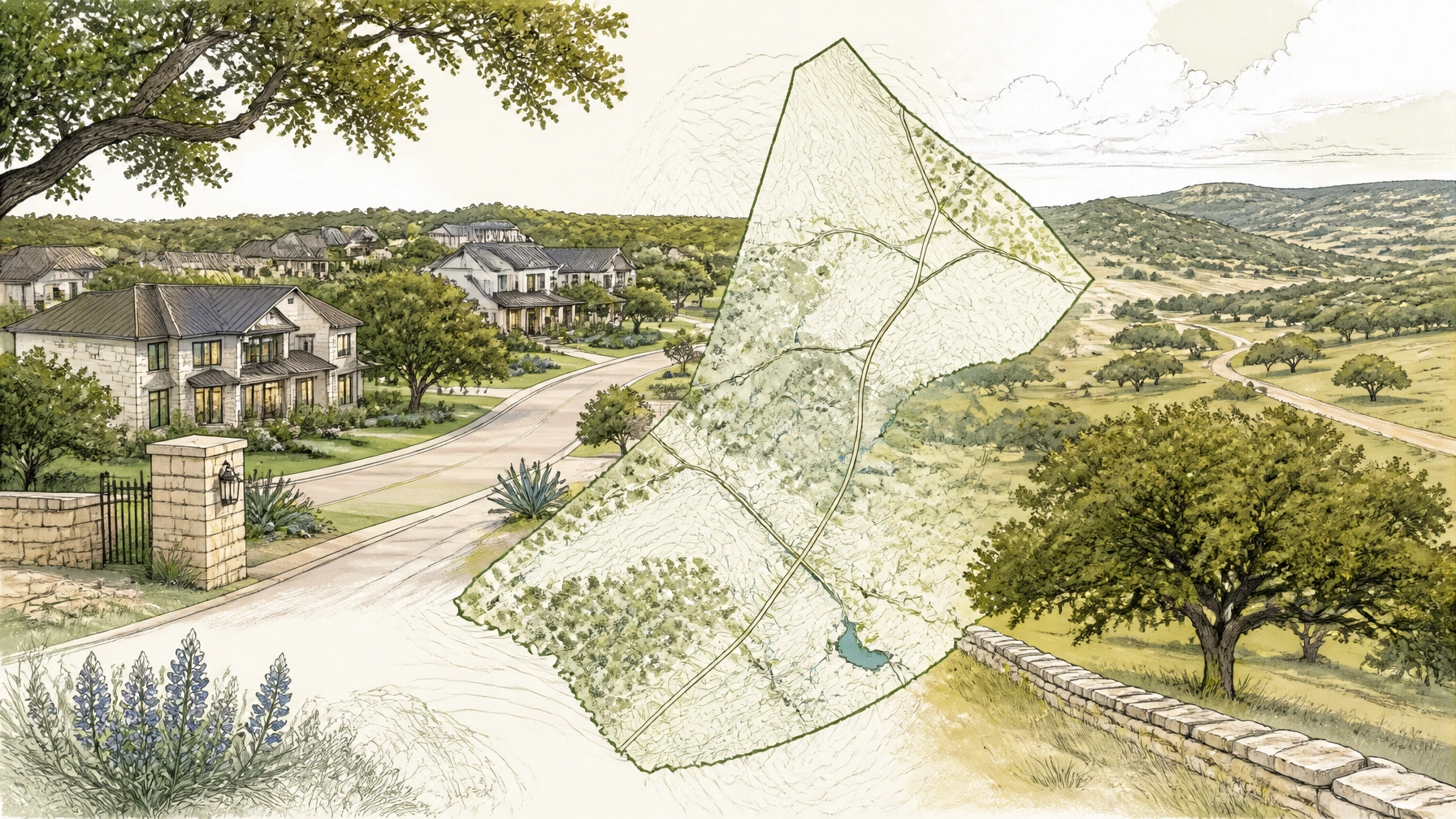
For years, luxury living around Austin was closely associated with large suburban homes, gated neighborhoods, and convenient access to retail and offices. Those priorities still matter: but a growing number of affluent buyers are redefining what luxury means.
Instead of adding another room or upgrading to a more prominent subdivision, they are looking for something harder to replicate: acreage, privacy, native landscapes, dark skies, and the freedom to shape daily life around the land.
That shift is drawing attention to Hays County, particularly Dripping Springs and nearby Hill Country communities. Here, buyers can find ranch-style properties that offer a more private setting while remaining connected to Austin’s cultural, professional, and medical resources.
For retirees and pre-retirees, the appeal goes beyond real estate. A ranch property can become the setting for a slower, more intentional chapter: one built around morning walks, outdoor entertaining, gardening, horses, family visits, and a deeper relationship with the surrounding landscape.
The New Definition of Luxury: More Land, Less Noise
Suburban luxury often focuses on finishes: larger kitchens, resort-style amenities, upgraded appliances, and carefully planned community spaces. Ranch luxury begins with a different question:
How do you want to live every day?
For many buyers, the answer includes:
- A long driveway instead of a row of neighboring homes
- Mature live oaks and native grasses
- A covered porch oriented toward the sunset
- Room for a guest casita, workshop, garden, or barn
- Trails and open space for walking
- Fewer sightlines into neighboring yards
- A quiet night sky without the glow of dense development
The value is not simply measured in square footage. It is measured in breathing room.
Dripping Springs has become especially attractive because it combines a recognizable small-town character with the scenery and scale associated with the Texas Hill Country. The city’s draft Reimagine Dripping Springs 2040 Comprehensive Plan describes the community’s long-term goal as managing growth while prioritizing “the preservation of the Hill Country character and the community’s sense of place.”
That language reflects what many luxury buyers are seeking: a home that feels connected to its region rather than interchangeable with a high-end suburb anywhere in the country.
Why Hays County Is Capturing Attention
Hays County offers a combination that is difficult to find in more established urban areas: larger parcels, Hill Country scenery, access to growing communities, and proximity to Austin.
The county is also experiencing substantial population growth. According to the U.S. Census Bureau’s QuickFacts data, Hays County had an estimated population of 304,390 on July 1, 2025, compared with a 2020 base estimate of 241,064. That increase of more than 63,000 residents in five years points to the broader momentum behind the region.
Growth does not guarantee that every property will appreciate, and land is not a substitute for a diversified financial plan. But population growth helps explain why buyers, builders, and service providers continue to focus on the Austin-Hill Country corridor.
For luxury households, Hays County’s appeal often comes down to four qualities:
1. Space for the way families actually live
Acreage gives a property flexibility. A home can support more than indoor living; it can accommodate outdoor kitchens, shaded patios, walking paths, gardens, recreation areas, and gathering spaces for children and grandchildren.
For retirees, that flexibility may also support a multigenerational lifestyle. A separate guest structure can offer family privacy without sacrificing connection. A workshop or studio can make room for a long-delayed creative pursuit. Even a simple trail through the property can turn an ordinary afternoon into an outdoor experience.
2. Privacy without total isolation
Privacy is one of the clearest reasons buyers are leaving dense suburban settings. Yet most people do not want to be completely disconnected from the world.
Dripping Springs offers a middle ground. Ranch properties can provide a greater sense of seclusion while still keeping residents within reach of restaurants, wineries, community events, health services, and Austin. That balance is particularly attractive to retirees who want peace and quiet: but not inconvenience.
The best properties often create privacy through thoughtful design rather than distance alone. Natural topography, mature vegetation, careful home placement, and screening trees can make a property feel secluded without requiring an extreme commute.

3. A lifestyle centered on the outdoors
A ranch property changes the rhythm of a day.
Coffee can happen beneath the oaks. Exercise can begin at the front door. Weekends can include a walk through the property, a visit to a nearby winery, or dinner outdoors with friends.
Dripping Springs’ International Dark Sky Community designation adds another dimension to the lifestyle. For buyers accustomed to urban light pollution, the night sky becomes part of the property’s experience: an amenity that cannot be installed after closing.
This nature-focused environment also supports a form of retirement wellness that feels less scheduled. Instead of driving to every activity, residents can build movement, fresh air, and time outside into their daily routines.
4. A sense of stewardship
Some buyers are not simply looking for land to own. They want land to care for.
Stewardship may mean restoring native grasses, protecting mature trees, maintaining a wildlife habitat, managing erosion, planting a pollinator garden, or preserving the character of a creek and its surrounding vegetation. For others, it may involve agricultural projects, responsible grazing, or maintaining a small family ranch.
This perspective changes the purchase from a purely transactional decision into a long-term relationship with a place. The property becomes part of a household’s identity and, in some cases, part of what they hope to share with future generations.

What This Means for the Dripping Springs Market
The movement from suburbs to ranch land is influencing more than buyer preferences. It is shaping the types of properties being designed, renovated, and brought to market.
Well-designed acreage may stand apart
As more buyers focus on land, properties with thoughtful improvements may gain attention. That does not necessarily mean the most expensive home wins. It may be the property that best integrates the home with its surroundings.
Important features can include:
- A home positioned to preserve views and mature trees
- Durable materials suited to the Hill Country climate
- Single-level living or adaptable spaces
- Efficient water and energy systems
- Functional outbuildings
- Outdoor spaces designed for shade and year-round use
- Good internet connectivity for remote work or family needs
- Clear access, fencing, and land-use documentation
Luxury buyers are becoming more discerning about the entire property: not just the kitchen, primary suite, or architectural style.
Infrastructure becomes part of the luxury conversation
Moving from a master-planned suburb to acreage also requires more investigation. A beautiful tract may have limitations involving water, septic systems, drainage, access, utilities, or construction potential.
The Hays County Development Services FAQs explain that development in unincorporated areas generally requires permitting. The county also states that an On-Site Sewage Facility permit is required regardless of lot size or acreage.
That makes due diligence essential. Buyers should understand how a property is served today, what improvements may be possible later, and which restrictions could affect a future home, guest house, pool, barn, or land project.
These questions are not reasons to avoid ranch property. They are part of understanding what you are buying.
The market may reward authenticity
As Hays County grows, the properties most aligned with the region’s character may become increasingly meaningful to buyers. A generic house on a large parcel may not offer the same experience as a home that respects the topography, protects the trees, and makes the most of the landscape.
This is one reason modern Hill Country architecture has become so popular. Limestone, metal roofing, shaded breezeways, large windows, and natural materials can create a home that feels contemporary while remaining rooted in its surroundings.
The long-term market story will depend on many factors, including interest rates, construction costs, inventory, infrastructure, and local development decisions. Still, the lifestyle demand behind the ranch-land movement appears durable: affluent households want more control over their environment and more meaning from the place they call home.
The Financial Planning Side of a Ranch Move
A ranch property can be deeply valuable as a lifestyle asset, but it is also a major use of capital. Buyers should consider the purchase alongside the rest of their financial picture.
A property with acreage may involve higher ongoing costs for maintenance, landscaping, fencing, roads, insurance, wells, septic systems, equipment, and property improvements. It may also concentrate more of a household’s net worth in an illiquid asset.
That is why a thoughtful plan should preserve flexibility elsewhere. A portfolio built around transparent, publicly traded markets: including long-term equity ownership and traditional fixed income: can provide liquidity for retirement income, unexpected repairs, travel, healthcare needs, and ongoing land expenses.
The goal is not to reduce the emotional value of the property. It is to make sure the ranch supports retirement rather than placing unnecessary pressure on it.

Is Ranch Living Right for Your Next Chapter?
Trading a suburb for ranch land is not simply a move to a larger property. It is a decision to prioritize space, privacy, nature, and personal rhythm over convenience at every doorstep.
For some buyers, the right answer may be a smaller acreage home close to Dripping Springs. For others, it may be a larger ranch with room for family, animals, gardens, or conservation projects. The right choice depends on how you want to spend your time: and how the property fits within your broader retirement plan.
Hays County is attracting luxury buyers because it offers a compelling version of Hill Country living: refined but relaxed, private but connected, and spacious without being completely removed from Austin.
If you are considering a move to Dripping Springs or the surrounding Hill Country, your real estate decision and financial plan should be evaluated together.
Schedule a private meeting with a fiduciary financial advisor today by calling (512) 593-8380 or by visiting: https://calendly.com/portafoliocapital/15min
Portafolio Capital Management dba Mau Sanchez Capital is a Registered Investment Adviser. This content is for informational purposes only and does not constitute investment advice or a solicitation to buy or sell any security. Advisory services are provided only pursuant to a written advisory agreement.
To learn more about Portafolio Capital Management dba Mau Sanchez Capital and its approach to transparent, liquid investment management, visit https://portafoliocapital.com/ or call (512) 593-8380.
This article may include stories, scenarios, and perspectives created or assisted by artificial intelligence. Although the individuals and circumstances described may be fictional, the topics are intended to reflect real financial, personal, and lifestyle issues that retirees and individuals commonly face.
The content is provided to encourage readers to consider different perspectives that may affect their retirement, regardless of whether they are currently planning, approaching retirement, or already retired. It is intended for general educational and informational purposes only and should not be interpreted as personalized investment, financial, tax, legal, medical, or retirement-planning advice.
Individual circumstances vary. Readers should independently verify any information presented and consult appropriately qualified professionals before making financial or personal decisions. No advisory, professional, or client relationship is created through the use of this website.
Leave a Reply