
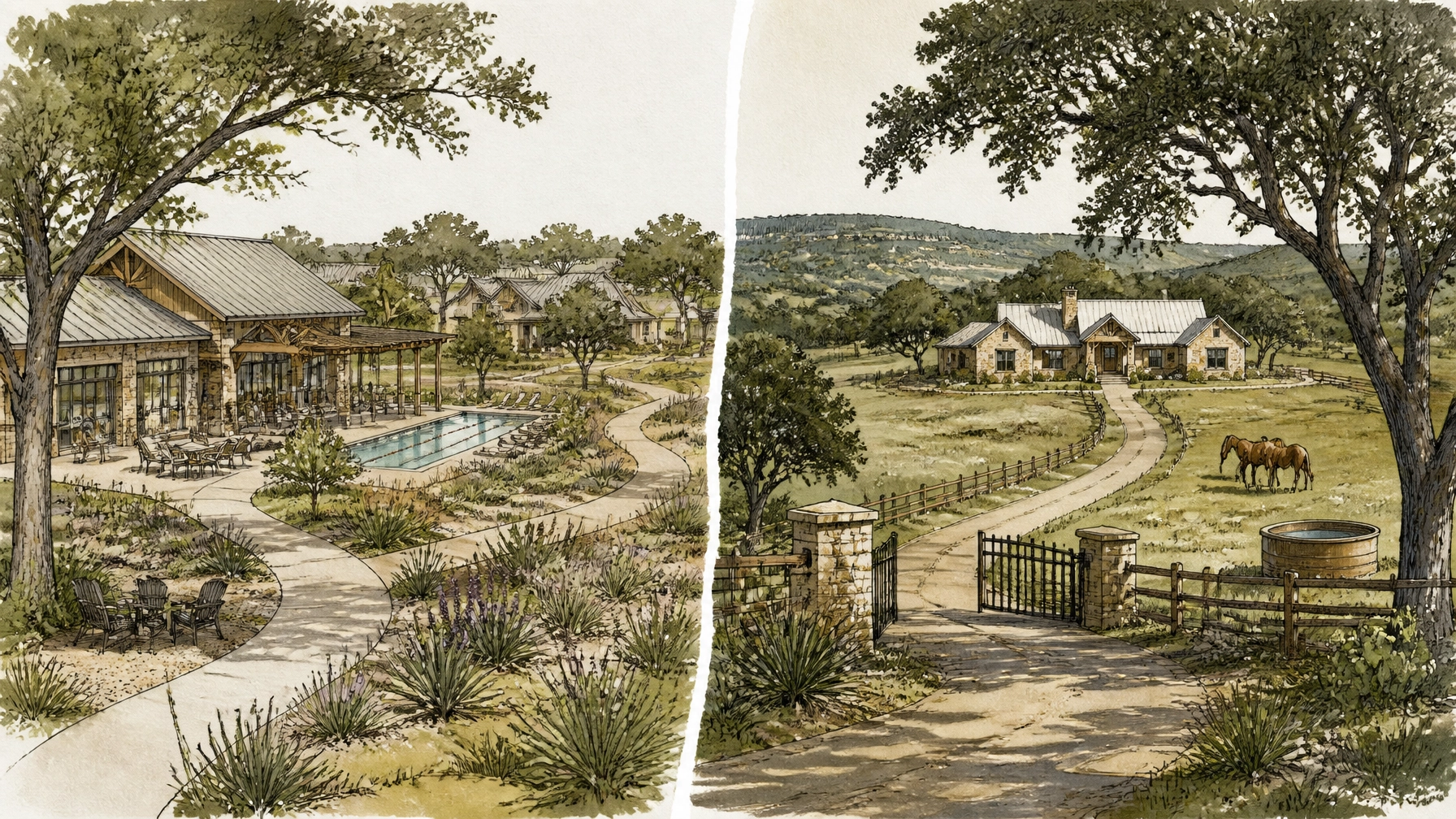
Retirement in the Dripping Springs area can take many forms. For some, the ideal day includes a morning walk, coffee with neighbors, and an evening gathering at a clubhouse or local restaurant. For others, retirement means sitting on a wide porch, watching wildlife move across the land, and enjoying the quiet of a private ranch.
Both lifestyles can be deeply rewarding. They simply solve different problems.
An active adult community generally prioritizes convenience, social connection, and reduced maintenance. A private ranch offers privacy, space, and greater control over your surroundings. The better choice depends less on which property is more impressive and more on how you want your days to feel at 65, 75, and beyond.
“The best retirement home is not necessarily the largest or most luxurious. It is the one that continues to support the life you want to live.”
The Short Answer
An active adult community may be a better fit if you value:
- Low-maintenance living
- Organized activities and easy social connection
- Nearby amenities and services
- A more predictable housing routine
- The possibility of remaining close to neighbors and community resources as your needs change
A private ranch may be a better fit if you value:
- Privacy and open space
- Gardening, animals, trails, or land stewardship
- Custom architecture and expansive views
- Independence from neighborhood rules
- A quiet, self-directed lifestyle
The important distinction is that a ranch is not simply a larger home. It is an ongoing responsibility involving land, infrastructure, access, security, water, landscaping, and maintenance.
Lifestyle: Built-In Activity or Self-Directed Freedom?
Active adult communities are designed around convenience and connection. Depending on the community, residents may have access to walking paths, fitness areas, pools, clubhouses, group activities, and social events. Even when participation is optional, the setting makes it easier to encounter other people during an ordinary day.
That structure can be especially appealing during the transition into retirement. Instead of rebuilding a social calendar from scratch, you may find neighbors who are also interested in travel, golf, wine tasting, fitness, gardening, or community events.
Dripping Springs already offers opportunities for outdoor recreation through places such as Dripping Springs Ranch Park, which includes multi-use trails and equestrian facilities. Nearby parks and nature destinations add to the area’s appeal for people who want an active Hill Country lifestyle without living on acreage.
A private ranch provides a different kind of freedom. You can decide whether the day includes tending a garden, walking a private trail, hosting family, caring for animals, or doing nothing at all. There is no shared activity calendar to follow and usually more room for hobbies that require land.
The tradeoff is that social connection requires more initiative. Friends may live several miles away, and most errands, appointments, restaurants, and cultural activities require driving. A private ranch can feel wonderfully peaceful, but it may also become isolating if transportation or mobility changes later in life.
Maintenance: What Do You Want to Manage?
One of the strongest arguments for an active adult community is the ability to exchange property responsibilities for convenience.
Many communities handle some combination of exterior maintenance, landscaping, common areas, and amenity upkeep through HOA dues or community fees. The exact arrangement varies, so it is important to review what is included before purchasing. Our guide to Dripping Springs homeowners associations discusses the importance of understanding rules, fees, architectural requirements, and possible future assessments.
Active adult living does not eliminate all maintenance. You still have utilities, insurance, interior repairs, and regular household responsibilities. However, you may have fewer large projects competing for your time and retirement income.
A private ranch requires a much broader maintenance plan. Depending on the property, responsibilities may include:
- Driveway and private-road upkeep
- Fence repairs
- Well and septic-system maintenance
- Brush clearing and tree management
- Irrigation and landscaping
- Barns, workshops, gates, and outbuildings
- Pool, pond, or water-feature maintenance
- Security and access control
- Livestock or equestrian care
You can hire professionals to handle much of this work. The question is whether those costs fit comfortably within your long-term spending plan. It is also worth considering whether dependable help will remain available as the property ages.

Social Connection and Community
For many retirees, community is not a luxury. It is part of a healthy and satisfying lifestyle.
An active adult community creates repeated opportunities to see the same people. That matters because friendships often grow through routine: walking the same path, attending a weekly class, joining a group outing, or sharing a meal. The setting can make it easier to build relationships after relocating.
Dripping Springs also has a broader community life beyond residential developments. New residents can explore local arts, wineries, restaurants, volunteer opportunities, and civic activities. The newcomer’s guide to Dripping Springs offers ideas for building connections during the first year.
A ranch can support meaningful community as well, particularly for people who already have strong relationships in the area or enjoy hosting. A large property may become the gathering place for family holidays, wine dinners, outdoor celebrations, or weekend visits.
Still, the social experience is more dependent on you. If you are comfortable driving, entertaining, joining local organizations, and reaching out to others, ranch living may feel expansive rather than isolated. If you prefer spontaneous interaction close to home, an active adult setting may be more practical.
Cost: Predictability Versus Scale
The financial comparison is more complicated than comparing a purchase price.
An active adult home may involve:
- Purchase price or entrance cost
- HOA dues or community fees
- Property taxes
- Homeowners insurance
- Utilities
- Interior maintenance
- Possible amenity or special-assessment charges
If the setting is an independent-living community rather than an age-restricted neighborhood, the monthly fee may also include services such as meals, housekeeping, transportation, or activities. These arrangements differ substantially, so compare contracts carefully.
A private ranch may involve:
- A larger purchase price
- Property taxes and insurance
- Larger utility and fuel costs
- Land and home maintenance
- Private-road or driveway upkeep
- Well and septic expenses
- Landscaping and brush management
- Security, equipment, and hired labor
Texas does not impose a state property tax, but local taxing units do levy property taxes. The Texas Comptroller explains that local entities: including school districts, counties, and municipalities: use property-tax revenue to fund public services. Ranch buyers should also investigate how the property is appraised and whether any agricultural or open-space valuation applies. Eligibility and ongoing requirements vary, so this is an area for qualified local guidance rather than assumptions.
The most useful comparison is an all-in annual budget. Do not compare only the monthly HOA fee with the ranch mortgage. Include maintenance reserves, insurance, property taxes, transportation, labor, utilities, and the opportunity cost of tying up substantial capital in a home.
Privacy, Control, and Personal Space
A private ranch wins decisively on privacy. You may have greater separation from neighbors, fewer shared amenities, and more control over outdoor spaces. For people who value quiet mornings, dark skies, and room to roam, that privacy may be central to the retirement dream.
The Dripping Springs Dark Sky designation also highlights the value many residents place on preserving the Hill Country’s nighttime environment. On a private property, outdoor lighting and landscape design can be tailored more closely to your preferences, subject to local rules and any deed restrictions.
An active adult community provides less solitude but may offer greater order and convenience. Shared standards can help maintain a cohesive appearance, and some residents appreciate not having to manage every decision about roads, landscaping, amenities, or neighboring properties.
The potential downside is reduced flexibility. HOA rules may address exterior changes, parking, fencing, pets, rentals, landscaping, and lighting. Before buying, review the governing documents and consider whether the rules support the way you actually want to live.

Long-Term Practicality and Aging in Place
A home can be ideal for today and difficult ten years from now. Retirement decisions should account for changing mobility, driving habits, health needs, and the possibility that one spouse may eventually manage the property alone.
Active adult communities often offer single-story layouts, shorter distances to shared amenities, and easier access to neighbors. Some independent-living settings may also have additional services nearby, although each community must be evaluated individually.
A private ranch can support aging in place if it is thoughtfully designed. Features such as a zero-step entry, wider doorways, accessible bathrooms, a first-floor primary suite, reliable lighting, and a manageable amount of acreage can make a substantial difference. Our article on custom homes and universal design in Dripping Springs explores why some retirees are building homes around long-term usability.
The larger question is what happens if driving becomes difficult or property maintenance becomes too demanding. A ranch plan should include transportation, household help, emergency access, medical appointments, and the cost of outsourcing physical work.
A Practical Decision Framework
Before choosing, ask yourself:
- Do I want my home to be a retreat or a social hub?
- How much land can I realistically maintain: or comfortably pay someone else to maintain?
- Would I use community amenities regularly, or would I prefer private outdoor space?
- How far am I willing to drive for healthcare, shopping, dining, and cultural activities?
- What happens if one spouse becomes responsible for the property alone?
- How much housing expense can my retirement income support during a difficult market?
- Would renting each type of property first help clarify the decision?

The Bottom Line
An active adult community is often the stronger choice for retirees who want convenience, connection, and a more manageable long-term routine. A private ranch may be the better fit for those who view land, privacy, and independence as essential parts of their retirement identity.
Neither option is universally better. The right choice is the one that aligns your housing, daily lifestyle, social needs, and long-term financial plan.
As you compare properties, consider how the decision affects liquidity, asset allocation, retirement income, insurance, maintenance reserves, and future flexibility. A beautiful home should enhance your retirement: not require you to organize your retirement around it.
Schedule a private meeting with a fiduciary financial advisor today by calling (512) 593-8380 or by visiting: https://calendly.com/portafoliocapital/15min
Portafolio Capital Management dba Mau Sanchez Capital is a Registered Investment Adviser. This content is for informational purposes only and does not constitute investment advice or a solicitation to buy or sell any security. Advisory services are provided only pursuant to a written advisory agreement.
To learn more about Portafolio Capital Management dba Mau Sanchez Capital, visit https://portafoliocapital.com/ or call (512) 593-8380.
This article may include stories, scenarios, and perspectives created or assisted by artificial intelligence. Although the individuals and circumstances described may be fictional, the topics are intended to reflect real financial, personal, and lifestyle issues that retirees and individuals commonly face.
The content is provided to encourage readers to consider different perspectives that may affect their retirement, regardless of whether they are currently planning, approaching retirement, or already retired. It is intended for general educational and informational purposes only and should not be interpreted as personalized investment, financial, tax, legal, medical, or retirement-planning advice.
Individual circumstances vary. Readers should independently verify any information presented and consult appropriately qualified professionals before making financial or personal decisions. No advisory, professional, or client relationship is created through the use of this website.
Leave a Reply