
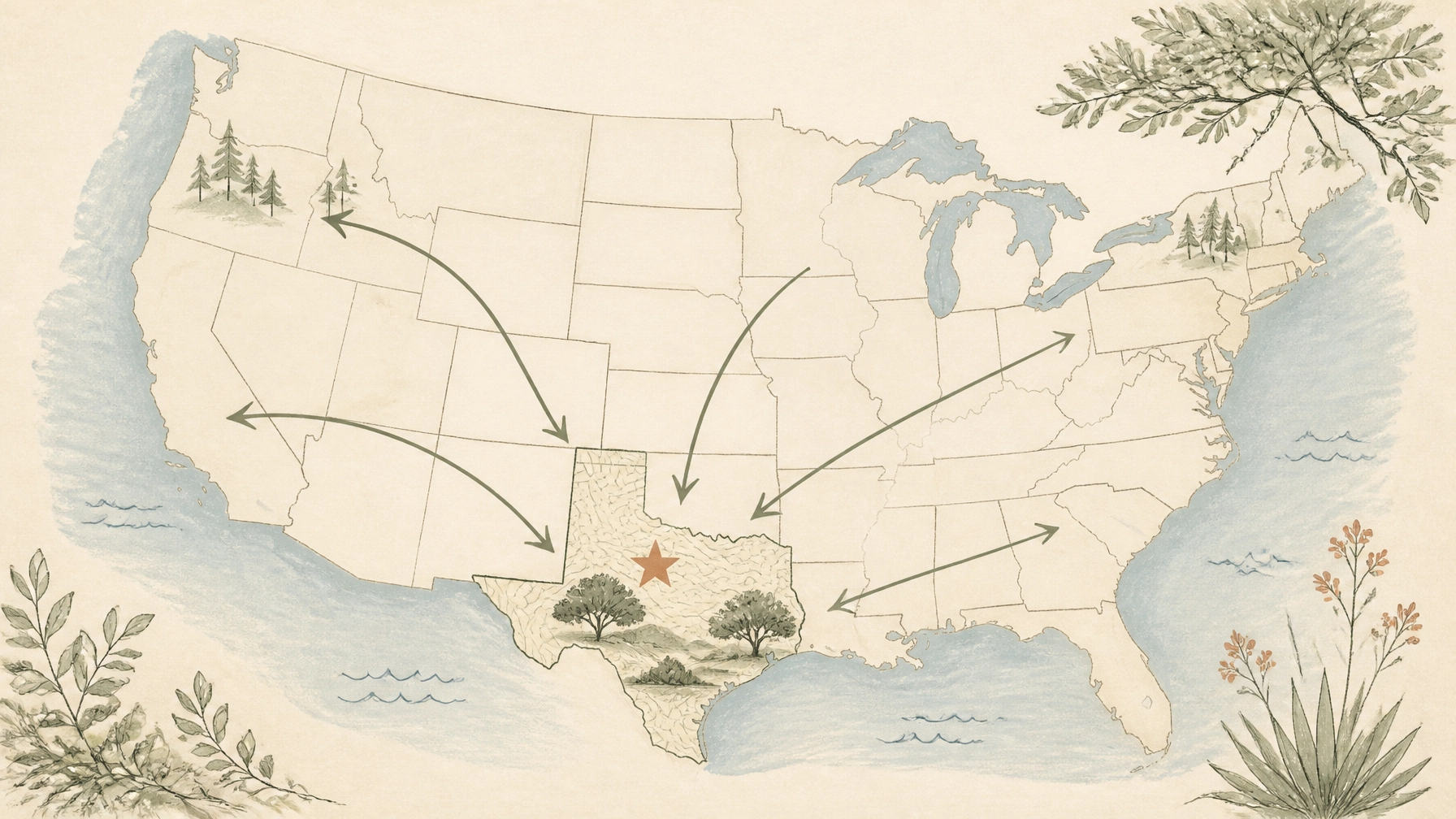
Texas is attracting retirees in numbers that are difficult to ignore.
According to recent migration research reported by AARP, Texas ranked second among states for both the number of retirement-age arrivals and net retirement-age migration in 2025. The study counted 24,079 inbound moves by adults age 65 and older, with Texas recording a net gain of 5,156 retirement-age residents.
That places Texas behind only South Carolina in net retiree migration, and ahead of many traditional retirement destinations.
The numbers tell us where retirees are moving. The more interesting question is why.
For many households, the answer is a combination of financial practicality, convenient access to major cities, warm weather, and a desire for a more spacious and meaningful daily life. Within that broader Texas story, the Hill Country, and especially Dripping Springs, offers a distinctive version of retirement: peaceful, polished, nature-focused, and still connected to the energy of Austin.
What the #2 ranking really means
Retirement migration rankings can vary depending on the source, year, and definition of “retiree.”
For example, SmartAsset’s 2025 study, based on U.S. Census Bureau data for 2023, defined retirees as people age 60 and older. That study ranked Texas sixth among states by net retiree migration, with 10,050 more retirees moving in than out.
The AARP analysis used a different dataset and focused on people age 65 and older moving during 2025. Under that methodology, Texas ranked second for net gain.
These findings are not contradictory. They demonstrate that migration research depends on the population measured and the period examined. The larger takeaway is consistent: Texas is firmly among America’s leading retirement destinations.
The state is not attracting retirees because of one single feature. It is attracting them because several important considerations align in the same place.
Why retirees continue to choose Texas
1. A favorable state tax structure
Texas does not impose a state individual income tax, a feature frequently cited as one reason retirees consider relocating there. This can be relevant for households drawing income from retirement accounts, pensions, business interests, or taxable investments.
However, no single tax feature determines whether a move is financially suitable. Property taxes, insurance, healthcare, transportation, home maintenance, and lifestyle spending all matter. A careful relocation decision should consider the household’s complete financial picture rather than focusing on one line item.
Still, the absence of a state individual income tax is an important part of Texas’s appeal, particularly for retirees comparing the state with high-tax areas of the Northeast, Midwest, or West Coast.
2. Access to major healthcare centers
AARP specifically notes Texas’s major medical centers as an attraction for older adults. Houston, San Antonio, Dallas-Fort Worth, and Austin provide access to broad healthcare networks, specialty providers, and advanced medical services.
For Hill Country retirees, this creates an appealing balance. Dripping Springs offers a quieter residential setting while remaining within reach of the greater Austin area’s medical, cultural, and commercial resources.
That balance matters. Many retirees are not looking for complete isolation. They want privacy and open space, but they also want reasonable access to airports, restaurants, physicians, hospitals, and family members.
3. A warm-weather lifestyle with room to breathe
Texas offers a warmer climate than many states losing retirement-age residents. In particular, households moving from California, New York, Illinois, and other high-cost or colder regions may be drawn to the opportunity to spend more time outdoors.
The Hill Country adds a particular sense of place. Limestone hills, live oak trees, seasonal wildflowers, winding roads, and broad skies create a setting that feels different from both dense urban neighborhoods and highly developed coastal retirement communities.
The lifestyle is active without requiring a resort atmosphere. A morning walk, a round of golf, an afternoon at a winery, or a quiet evening on the porch can become part of a sustainable daily rhythm.

Why the Hill Country stands apart
Texas is a large and diverse state. Retirement in Houston looks very different from retirement in the Panhandle, the Gulf Coast, or the Dallas area.
The Hill Country stands apart because it brings together four qualities that many affluent retirees value.
Proximity without constant city intensity
Dripping Springs is close enough to Austin to benefit from the region’s airport, dining, arts, music, healthcare, and business connections. At the same time, it offers a more relaxed setting than a downtown condominium or dense suburban development.
For executives, business owners, and professionals transitioning into retirement, this can make the move feel less like giving something up and more like changing the pace.
Upscale homes with a stronger connection to the land
The Hill Country has become known for custom homes, modern ranch architecture, acreage properties, and luxury communities designed around the landscape.
That does not mean every retiree needs a large ranch or expansive acreage. The better question is how a home supports the life you want to live. Some households may prefer a low-maintenance residence near town. Others may want space for gardens, workshops, visiting family, or outdoor entertaining.
Our guide to why more retirees are choosing custom homes over resale explores how design and long-term livability can influence the relocation decision.
Nature as part of the daily routine
In many retirement destinations, outdoor recreation is something residents drive to on weekends. In Dripping Springs, the landscape can be part of ordinary life.
Residents may enjoy nearby trails, parks, ranch roads, scenic overlooks, vineyards, and outdoor gathering spaces. The region’s International Dark Sky designation adds another dimension: evenings can be quieter, darker, and more connected to the natural environment.
For retirees focused on wellness and slower living, that kind of setting may be more valuable than a long list of amenities.
A community that makes it easier to build a new chapter
Moving in retirement is not only a housing decision. It is a social decision.
Dripping Springs offers farmers markets, local festivals, wine and food events, volunteer opportunities, art activities, outdoor groups, and community organizations. The Dripping Springs social calendar provides an example of how the area’s events create recurring opportunities to meet people.
As one AARP source quoted Miranda Marquit of HireAHelper:
“You’re on a fixed income, and you’re looking at these costs going up, and so folks are saying, ‘OK, let’s move.’”
That observation speaks to affordability, but retirement relocation is rarely about cost alone. People are also searching for belonging, purpose, beauty, and a community where their time feels like their own.

The financial side of a Hill Country move
A move to Dripping Springs may involve selling a longtime home, purchasing or building a new residence, adjusting insurance and maintenance costs, and repositioning investments around a different spending pattern.
That is where retirement income planning becomes important: not as a technical exercise separate from lifestyle, but as a way to connect your assets with the life you want to enjoy.
A thoughtful plan may consider:
- How much liquidity should remain available after purchasing a home
- How investment withdrawals may change after relocation
- Whether the portfolio’s asset allocation reflects your time horizon and spending needs
- How to manage market risk without creating unnecessary complexity
- How to maintain transparency and cost efficiency in publicly traded investments
- Whether your financial plan can support travel, hospitality, charitable giving, and outdoor activities
The goal is not to predict every future expense. It is to create a flexible framework that helps you make major decisions with greater clarity.

Does Dripping Springs lead the pack?
National migration studies generally report at the state or major-city level. They do not provide a precise count of how many retirement-age households moved specifically to Dripping Springs.
So it would be inaccurate to claim that Dripping Springs is officially ranked as America’s top retirement town.
But from a lifestyle perspective, Dripping Springs represents many of the qualities driving Texas’s strong retirement migration numbers: access to a major metropolitan area, warm weather, a lower-density environment, outdoor recreation, a growing culinary and winery culture, and a strong sense of community.
It is a place for retirees who want more than a change of address. They may be looking for a setting that supports morning walks, long lunches, family visits, creative pursuits, live music, and evenings beneath a wide Texas sky.
That is why the Hill Country continues to attract attention: and why Dripping Springs is increasingly part of the conversation for households designing their next chapter.
Planning your own Texas retirement move
Before choosing a destination, spend time experiencing the area in more than one season. Explore neighborhoods at different times of day. Visit local restaurants and healthcare facilities. Drive the routes you would use regularly. Consider how your home, social life, travel plans, and investment strategy would work together.
A retirement move should support both the lifestyle you want today and the flexibility you may need later.
If you are considering Dripping Springs or the Austin Hill Country, schedule a private meeting with a fiduciary financial advisor today by calling (512) 593-8380 or by visiting: https://calendly.com/portafoliocapital/15min
Portafolio Capital Management dba Mau Sanchez Capital is a Registered Investment Adviser. This content is for informational purposes only and does not constitute investment advice or a solicitation to buy or sell any security. Advisory services are provided only pursuant to a written advisory agreement.
To learn more about Portafolio Capital Management dba Mau Sanchez Capital, visit https://portafoliocapital.com/ or call (512) 593-8380.
This article may include stories, scenarios, and perspectives created or assisted by artificial intelligence. Although the individuals and circumstances described may be fictional, the topics are intended to reflect real financial, personal, and lifestyle issues that retirees and individuals commonly face.
The content is provided to encourage readers to consider different perspectives that may affect their retirement, regardless of whether they are currently planning, approaching retirement, or already retired. It is intended for general educational and informational purposes only and should not be interpreted as personalized investment, financial, tax, legal, medical, or retirement-planning advice.
Individual circumstances vary. Readers should independently verify any information presented and consult appropriately qualified professionals before making financial or personal decisions. No advisory, professional, or client relationship is created through the use of this website.
Leave a Reply