
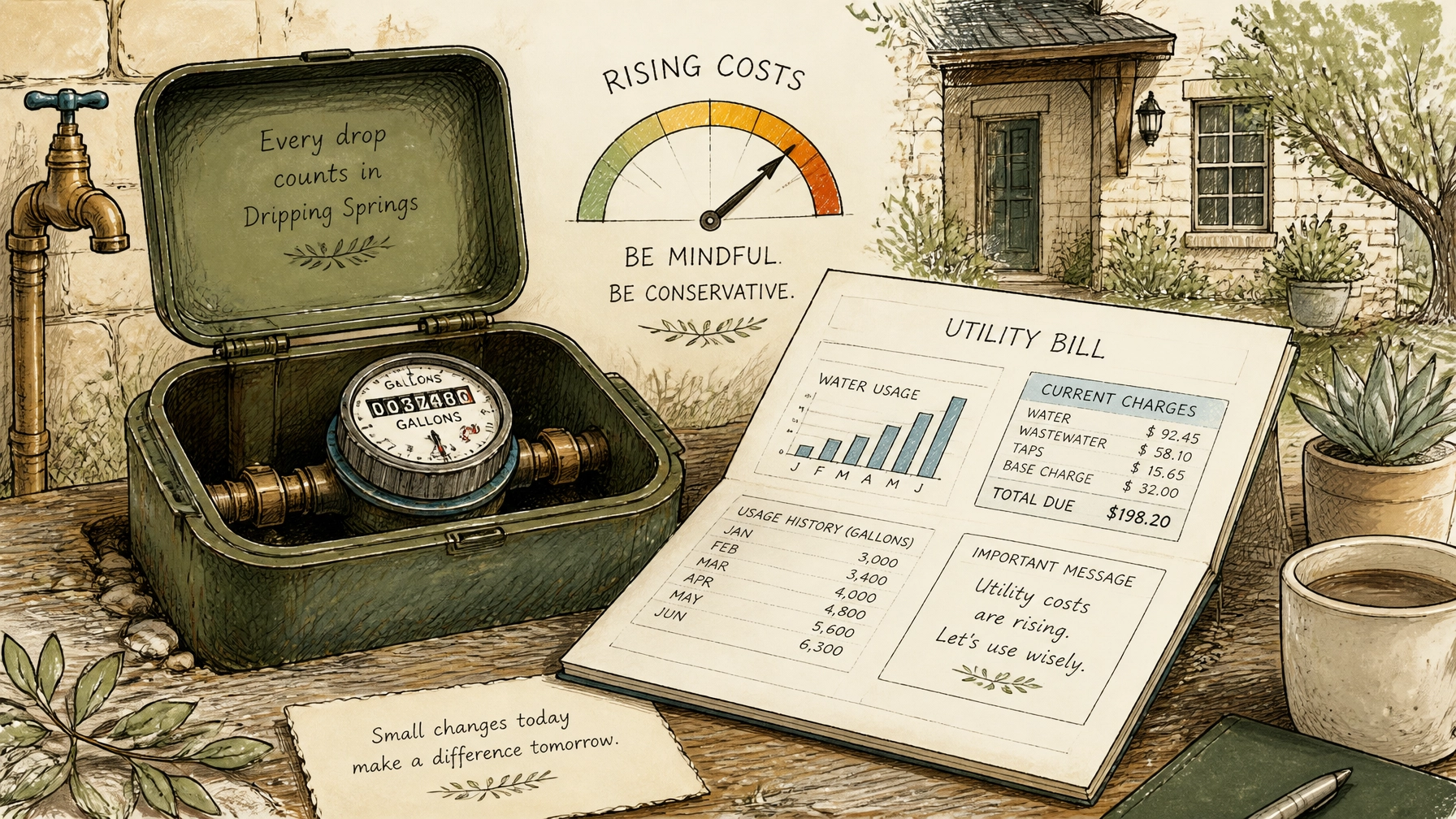
For many people, retiring in Dripping Springs means trading traffic and city congestion for oak-covered properties, peaceful porches, local wineries, and a slower Hill Country rhythm.
That lifestyle still comes with household costs that deserve careful attention. Beginning with the September 2026 billing cycle, many City of Dripping Springs utility customers will see higher water and wastewater charges. For a typical residential customer, the increase is expected to be approximately $20 to $30 per month, depending on usage.
That may not sound dramatic in isolation. Over a full year, however, it represents roughly $240 to $360 in additional spending: and the increase arrives alongside the ordinary costs of maintaining a home in Central Texas, including insurance, repairs, landscaping, and summer cooling.
The good news is that retirees and pre-retirees can prepare before the first higher bill arrives.
What is changing on Dripping Springs utility bills?
The largest change is connected to wastewater service. The City of Dripping Springs approved wastewater rate adjustments in 2026, with the new charges scheduled to appear on September utility bills.
According to the City of Dripping Springs wastewater rate adjustment information, most residential customers should expect an increase of approximately $20 to $30 per month, depending on water usage.
Local reporting from KVUE and KXAN describes the wastewater adjustment as nearly 40% for many average customers. City materials indicate that sample wastewater bills could rise from approximately $50 to $73 per month or from $60 to $88, depending on usage.
The City describes the expected impact for most residential customers as “approximately $20 to $30 per month.” : City of Dripping Springs
The city has also approved a comparatively modest adjustment to water rates. The most noticeable change for many city customers will therefore come from the wastewater portion of the bill rather than from water consumption alone.
The City’s current billing rates page is the best place to review the city’s posted information and confirm which charges apply to your account.
When will retirees see the increase?
The updated charges are scheduled to begin with September 2026 billing. City communications indicate that September bills are expected to be sent during the week of September 7.
That timing makes early September a useful moment to review your retirement household budget. Rather than waiting for the first bill and adjusting reactively, you can build the expected increase into your monthly plan now.
A simple starting point is to use three scenarios:
- Lower estimate: Add $20 per month, or $240 per year.
- Middle estimate: Add $25 per month, or $300 per year.
- Higher estimate: Add $30 per month, or $360 per year.
If you are moving to Dripping Springs, use the higher estimate until you can review an actual bill for the specific property. This is particularly important if you are considering a larger home, acreage, extensive landscaping, or a property with a pool.

Why are wastewater rates increasing?
Utility systems must expand and maintain infrastructure as communities grow. Wastewater service requires treatment capacity, collection systems, maintenance, staffing, regulatory compliance, and long-term capital improvements.
Dripping Springs has experienced significant residential and commercial growth in recent years. The city’s rate adjustment is intended to support the costs associated with providing and maintaining wastewater service as demand increases.
The city’s May 2026 press release provides additional background on the decision. The rate increase is not simply a fee added to a household bill without an underlying service cost. It reflects the expense of operating and improving a utility system in a rapidly developing community.
For retirees, this is an important reminder: the cost of a home is more than its purchase price, mortgage, or property taxes. Ongoing municipal services and infrastructure-related charges also affect the cost of living.
First, identify which utility system serves your home
Not every Dripping Springs-area household receives water from the City of Dripping Springs.
Some properties are served by the Dripping Springs Water Supply Corporation, a separate utility provider with its own rates, fees, and policies. The Dripping Springs Water Supply Corporation rate page states that its current water rates were approved in September 2025 and became effective December 1, 2025.
For DSWSC customers, the rate page lists a monthly minimum charge of $35 and tiered water charges based on consumption. It also notes that new meter and installation fees were approved in August 2026 and became effective September 1, 2026.
This distinction matters:
- City utility customers: The major September 2026 change is the city’s wastewater adjustment, along with a modest water adjustment.
- Dripping Springs Water Supply Corporation customers: The posted water-use rates were already effective in December 2025, while the meter and installation fee changed in September 2026.
- Electric and natural gas customers: These services are separate from the city’s water and wastewater decision. Any changes depend on your individual provider, rate plan, or contract.
Before purchasing a home, ask the seller, builder, homeowners association, or utility provider exactly which system serves the property. A beautiful Hill Country home can have a very different monthly operating profile depending on its water source, wastewater arrangement, irrigation system, and acreage.
Five ways to prepare your retirement budget
1. Add a permanent utility cushion
Do not treat the increase as a one-time expense. Add $25 to $30 to your recurring monthly household budget and assume the higher charge will continue.
If your income is structured around monthly withdrawals, pensions, Social Security, or other regular cash flow, recurring expenses should be reflected in the amount you need to receive each month.
A $30 monthly increase is manageable for many households, but it is easier to absorb when it is planned rather than discovered.
2. Review your last 12 months of utility bills
Look for seasonal patterns, not just your most recent bill. A home may use more water during hot weather, when landscaping, pools, guests, and outdoor activities increase consumption.
Create a simple list showing:
- Average monthly water usage
- Highest-use month
- Lowest-use month
- Wastewater charges
- Irrigation charges, if applicable
- Any unusual spikes
This can help you determine whether your household is likely to fall near the lower or higher end of the estimated increase.
3. Check for leaks and inefficient fixtures
A small leak can become more expensive when rates rise. Inspect toilets, faucets, outdoor spigots, irrigation valves, and visible plumbing connections.
Inside the home, low-flow showerheads, efficient toilets, and updated appliances may help reduce water use without changing your lifestyle. Outside, repairing broken irrigation heads and adjusting watering schedules can prevent unnecessary consumption.
Retirees who enjoy gardening or maintaining native landscaping can often reduce water demand by choosing plants suited to the Hill Country climate. This supports both household budgeting and the natural character of the region.
4. Be thoughtful with acreage and outdoor features
Acreage living is one of the great attractions of Dripping Springs, but larger properties can create higher operating costs. Before purchasing, estimate the cost of:
- Irrigation
- Well or water-system maintenance
- Septic or wastewater service
- Pool care
- Landscaping
- Fencing and gates
- HVAC maintenance
- Roofing and exterior upkeep
A property with a large lawn may require substantially more water than a home designed around native plants and shaded outdoor spaces.
When evaluating a future home, consider features that can support long-term efficiency, such as shade trees, high-performance windows, smart irrigation controls, rainwater collection, and drought-tolerant landscaping. Our earlier discussion of custom homes and retirement-friendly design in Dripping Springs explores how design choices can influence comfort and operating costs over time.

5. Keep your portfolio and cash flow flexible
A rising utility bill is a small example of a larger retirement planning principle: everyday expenses tend to change over time.
A retirement portfolio should account for recurring spending, unexpected repairs, healthcare costs, inflation, and lifestyle goals. Maintaining an appropriate balance of liquid investments and longer-term assets can make it easier to handle changing expenses without disrupting your overall plan.
At Mau Sanchez Capital, the general philosophy emphasizes transparent, liquid, publicly traded markets, thoughtful asset allocation, risk management through portfolio construction, and cost efficiency. The objective is not to predict every future bill. It is to help ensure that your financial resources remain aligned with the life you want to live.
“A home is often the largest single asset in a retiree’s portfolio, but it is also the least liquid.” : Mau Sanchez
That observation is especially relevant in the Hill Country, where homeowners may choose larger properties, custom construction, or acreage. The home may provide tremendous lifestyle value, but it also requires an ongoing plan for utilities, maintenance, insurance, and improvements.
A higher bill does not have to change the Hill Country lifestyle
The September 2026 utility adjustment is worth taking seriously, but it does not have to undermine the appeal of retiring in Dripping Springs.
For most households, the increase can be managed through a modest budget adjustment, a review of water usage, and careful consideration of property-related operating costs. The goal is to understand the complete cost of the lifestyle: not to give up the shaded porch, native garden, weekend winery visits, or outdoor space that makes the area so appealing.
If you already live in Dripping Springs, review your September bill carefully and confirm whether you are a city customer or served by another provider. If you are considering a move, request recent utility information for the property before making a decision.
Schedule a private meeting with a fiduciary financial advisor today by calling (512) 593-8380 or by visiting: https://calendly.com/portafoliocapital/15min
Portafolio Capital Management dba Mau Sanchez Capital is a Registered Investment Adviser. This content is for informational purposes only and does not constitute investment advice or a solicitation to buy or sell any security. Advisory services are provided only pursuant to a written advisory agreement.
To learn more about how Portafolio Capital Management dba Mau Sanchez Capital helps retirees coordinate investment management with their desired lifestyle, visit https://portafoliocapital.com/ or call (512) 593-8380.
This article may include stories, scenarios, and perspectives created or assisted by artificial intelligence. Although the individuals and circumstances described may be fictional, the topics are intended to reflect real financial, personal, and lifestyle issues that retirees and individuals commonly face.
The content is provided to encourage readers to consider different perspectives that may affect their retirement, regardless of whether they are currently planning, approaching retirement, or already retired. It is intended for general educational and informational purposes only and should not be interpreted as personalized investment, financial, tax, legal, medical, or retirement-planning advice.
Individual circumstances vary. Readers should independently verify any information presented and consult appropriately qualified professionals before making financial or personal decisions. No advisory, professional, or client relationship is created through the use of this website.
Leave a Reply