
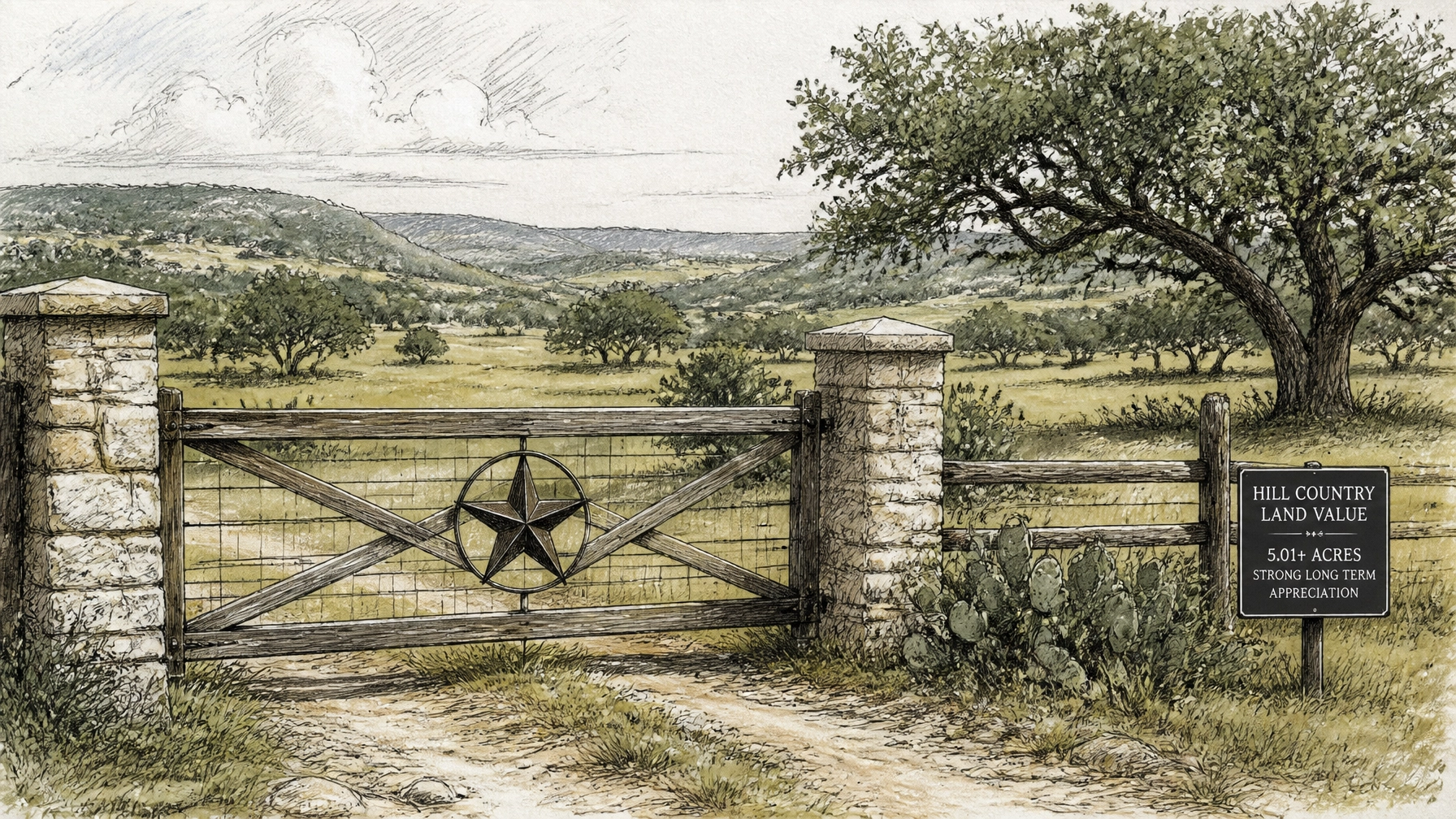
For years, buying Hill Country acreage was primarily a lifestyle decision. Families wanted room for horses, weekend gatherings, gardens, or a quiet place to enjoy the landscape.
Today, the equation has changed.
Luxury ranch buyers are still looking for privacy and beauty, but they are also competing for a limited supply of properties near Austin, wineries, outdoor amenities, and the growing communities of Hays County. In many of the most desirable Hill Country corridors, acreage values have roughly doubled over the past decade: and premium tracts can command substantially more than broad rural-land averages.
The important distinction is that not every acre has appreciated equally. A remote, unimproved tract and a carefully positioned estate near Dripping Springs are not the same market. Location, water, views, improvements, access, and development potential can make a dramatic difference.
The latest numbers show a market still moving higher
The broader Austin–Waco–Hill Country region is one of the clearest examples of Texas land-market strength.
According to the Texas Real Estate Research Center’s first-quarter 2026 report, the region’s median rural land price reached $8,028 per acre, an increase of 8.27% year over year. The report also recorded:
- 1,078 annualized sales, up 5.27% year over year
- More than 53,500 acres sold
- Total dollar volume of approximately $429.9 million, up 18.72%
The report cautions that its figures represent a mixture of land uses and conditions, primarily larger rural tracts. They should not be treated as an appraisal for any specific ranch.
Even so, the direction is clear. The Land Report’s coverage of the 2025 Texas land market, which summarizes Texas A&M data, reported that the same region reached approximately $7,911 per acre at the end of 2025: an all-time high for the region.
The luxury market sits above these averages. Smaller estate properties with exceptional views, live water, completed residences, guest accommodations, vineyards, equestrian facilities, or convenient access to Austin can carry a much higher price per acre.
That is why national luxury-market headlines can sound dramatically different from statewide agricultural statistics. One measures a broad blend of rural transactions. The other often focuses on the rarest, most desirable properties.
“Everything went crazy in the land market after COVID,” said Dr. Charles Gilliland, a research economist with the Texas Real Estate Research Center, in comments published by The Land Report.
The market has become more measured since the extraordinary buying surge of 2020 through 2022. But “more measured” does not mean demand has disappeared. It means buyers are paying closer attention to quality, pricing, financing, and long-term usefulness.
Why buyers value acreage beyond the house
Luxury Hill Country buyers are not simply purchasing square footage. They are purchasing an environment.
Privacy that cannot be replicated in a subdivision
A well-located ranch can provide a sense of separation that is difficult to create on a suburban lot. Mature trees, rolling terrain, long driveways, and natural boundaries offer quiet without placing a buyer hours from restaurants, medical care, cultural events, or the airport.
For retirees and pre-retirees, this privacy can be part of a slower, more restorative daily routine. Morning walks, outdoor breakfasts, gardening, and evening conversations under the stars become part of the property’s value.
A stronger connection to the landscape
Many luxury buyers want architecture that fits the land rather than overpowering it. Native limestone, shaded patios, outdoor kitchens, walking paths, and carefully planned views allow the home to become part of the surrounding Hill Country.
This connects closely with the broader trend toward investing in the Dripping Springs lifestyle. The appeal is not only potential long-term value. It is the everyday benefit of living near open space, wineries, trails, and the region’s distinctive natural character.
Flexibility for the next stage of life
Acreage can support a variety of lifestyles:
- A single-level retirement residence
- A guesthouse for visiting family
- A private studio or office
- A hobby vineyard or garden
- Space for pets, horses, or outdoor recreation
- A gathering place for children and grandchildren
That flexibility can be especially attractive to affluent families who want a home that serves several generations without feeling like a crowded vacation property.
Scarcity
There is a basic economic reality behind the market: desirable land is limited.
Texas Land Trends, a research project tracking changes in the state’s working lands, reports that Texas working-land values rose from an average of $1,951 per acre in 2017 to $3,021 per acre in 2022. The project also notes that the largest increases have occurred near major metropolitan areas, where population growth and demand place pressure on the remaining rural landscape. Explore the Texas Land Trends data.
In other words, the land most people want: scenic, accessible, private, and close to amenities: is also the land most exposed to development pressure.

The Hays County effect
Dripping Springs sits within a larger Hays County growth story.
The U.S. Census Bureau’s QuickFacts profile for Hays County lists a 2020 population of approximately 241,000 and a 2025 estimate of roughly 304,000. That represents an increase of about 26% in five years.
The county also grew by more than 50% between 2010 and 2020, placing it among the fastest-growing counties in the country during that period.
Growth brings new services, roads, businesses, schools, and amenities. It also changes the character of the land market. As more people seek access to the Austin region, properties that once felt purely rural may become attractive for residential, hospitality, or lifestyle uses.
For luxury buyers, Hays County offers an unusual combination:
- Hill Country scenery and open space
- Proximity to Austin’s employment and cultural centers
- Wineries, tasting rooms, restaurants, and event venues
- Access to outdoor recreation
- A growing network of services
- A recognizable small-town identity
That combination helps explain why Dripping Springs acreage can trade at a premium to broader regional averages. Buyers are not only paying for land. They are paying for land in a place where they expect to spend meaningful time.
What longtime owners should understand
For longtime ranch and acreage owners, rising values can create substantial financial flexibility. A property purchased years ago may now represent one of the largest assets on a household balance sheet.
But a high market value is not the same as spendable cash.
Land is generally illiquid. Selling can take time, and the final result depends on market conditions, property characteristics, buyer financing, and the difference between asking prices and completed transactions. Owners should also be cautious about assuming that every nearby listing represents the value of their own property.
A realistic review should consider:
- Recent closed sales, not only asking prices
- Acreage size and configuration
- Road access and utility availability
- Water sources and restrictions
- Improvements and deferred maintenance
- Views, terrain, and usable land
- Development or subdivision limitations
- Ongoing insurance, maintenance, and property costs
For some owners, the right decision may be to sell. For others, it may be to retain the property, improve it, or use a portion of its value to support retirement goals.
The key is to evaluate the land as part of the complete household picture: not in isolation.
What prospective buyers should consider
Acreage buyers should resist the temptation to treat every Hill Country property as a guaranteed appreciation story.
The market is strong, but high prices create higher expectations. Buyers should focus on the experience they want to have and the practical responsibilities they are willing to accept.
Before purchasing, investigate:
- Water availability and conservation requirements
- Septic systems or wastewater service
- Road maintenance and emergency access
- Wildfire exposure and insurance costs
- Property taxes and ongoing upkeep
- Internet and cell service
- Restrictions on building, lighting, fencing, or land use
- Travel time to medical care and everyday services
A beautiful ranch can be an exceptional home, but it may also require more management than a traditional residence. As discussed in our guide to custom homes for retirement in Dripping Springs, thoughtful design and careful planning can make a major difference in long-term comfort.

The portfolio question behind a ranch purchase
For retirees, one of the most important questions is not simply, “Can we afford the property?”
It is, “How will this property fit with the rest of our financial life?”
A luxury ranch may represent a meaningful share of total wealth. That concentration can affect liquidity, cash-flow planning, and the amount available for travel, healthcare, family support, and ongoing living expenses.
A balanced approach may include:
- Keeping sufficient accessible reserves for near-term needs
- Reviewing how the purchase changes overall asset allocation
- Avoiding forced sales of market investments to fund property costs
- Understanding the ongoing expenses of acreage ownership
- Maintaining a transparent portfolio of publicly traded stocks and traditional fixed income
- Evaluating the plan under both favorable and unfavorable market conditions
The goal is not to discourage a Hill Country lifestyle. It is to make sure the lifestyle remains sustainable after the closing documents are signed.

A premium market: but not a one-size-fits-all market
Hill Country acreage has become more valuable because it offers something increasingly difficult to find: private land, natural beauty, and access to a major metropolitan area.
Prices have risen sharply, and many premium corridors have roughly doubled in value over the past decade. Still, the future value of a particular ranch will depend on its location, quality, water, improvements, market timing, and the needs of future buyers.
For buyers, the lesson is to purchase the lifestyle intentionally. For longtime owners, it is to understand what the property may mean within a broader retirement plan. And for both, it is important to distinguish a beautiful asking price from a verified market value.
The Hill Country remains a compelling place to live. The best decisions will combine appreciation awareness with practical planning.
Schedule a private meeting with a fiduciary financial advisor today by calling (512) 593-8380 or by visiting: https://calendly.com/portafoliocapital/15min
Portafolio Capital Management dba Mau Sanchez Capital is a Registered Investment Adviser. This content is for informational purposes only and does not constitute investment advice or a solicitation to buy or sell any security. Advisory services are provided only pursuant to a written advisory agreement.
To learn more about Portafolio Capital Management dba Mau Sanchez Capital, visit https://portafoliocapital.com/ or call (512) 593-8380.
This article may include stories, scenarios, and perspectives created or assisted by artificial intelligence. Although the individuals and circumstances described may be fictional, the topics are intended to reflect real financial, personal, and lifestyle issues that retirees and individuals commonly face.
The content is provided to encourage readers to consider different perspectives that may affect their retirement, regardless of whether they are currently planning, approaching retirement, or already retired. It is intended for general educational and informational purposes only and should not be interpreted as personalized investment, financial, tax, legal, medical, or retirement-planning advice.
Individual circumstances vary. Readers should independently verify any information presented and consult appropriately qualified professionals before making financial or personal decisions. No advisory, professional, or client relationship is created through the use of this website.
Leave a Reply