
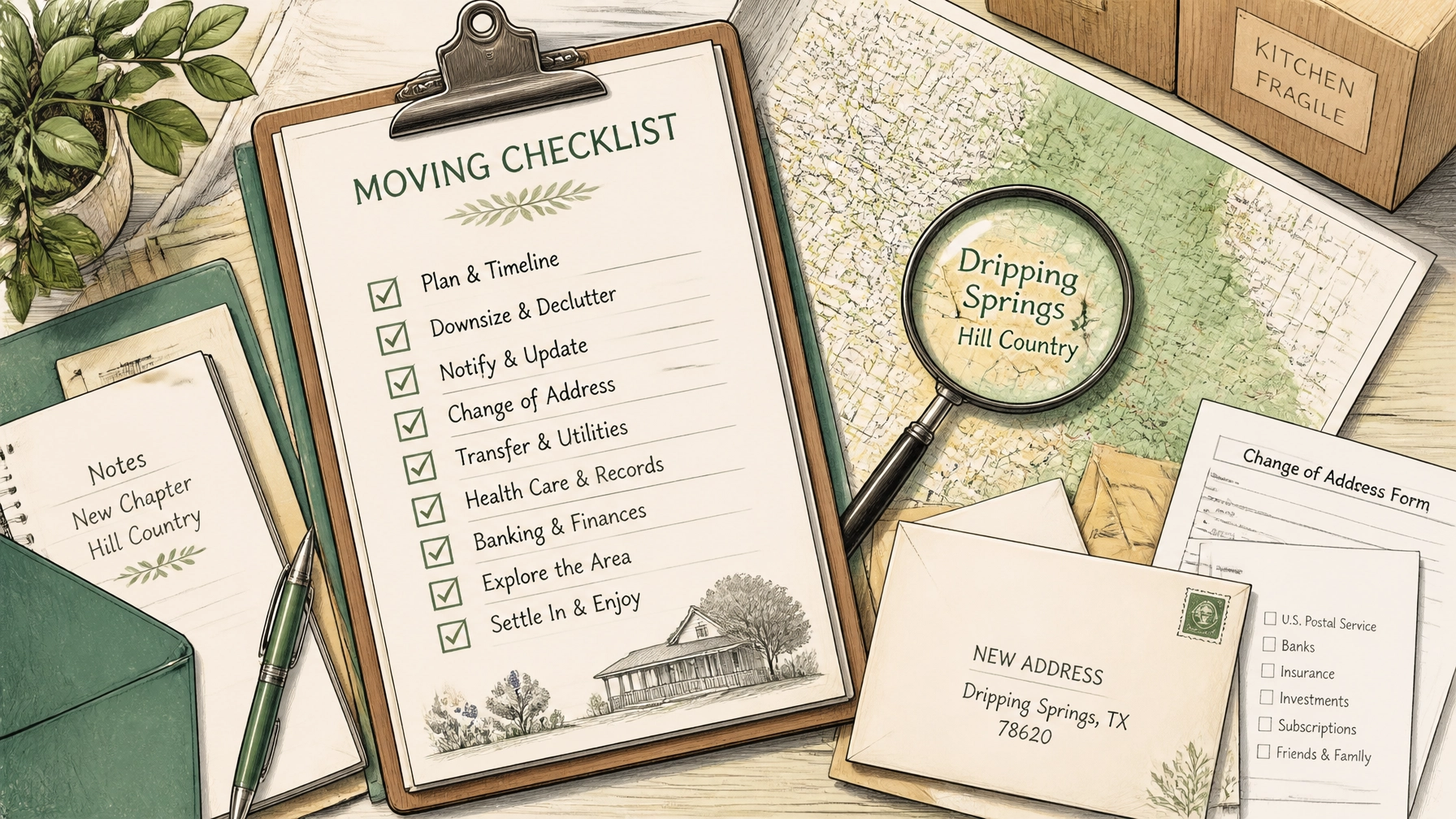
Moving to Texas can mean more sunshine, more space, and a slower pace: especially if you are considering Dripping Springs and the Austin Hill Country. But a successful relocation requires more than finding a beautiful home and scheduling the moving truck.
Residency documentation, property taxes, insurance, utility costs, vehicle requirements, healthcare access, and daily lifestyle expectations can all affect your budget and peace of mind. These details are manageable when you plan for them early. They can become expensive or stressful when they are overlooked.
Here are seven realities to review before establishing your new life in Dripping Springs.
1. Domicile Is More Than Spending Time in Texas
“Domicile” generally refers to your permanent home: the place you intend to make your primary and lasting residence. For retirees and pre-retirees moving from another state, establishing Texas domicile should be approached as a coordinated administrative process rather than a single form or declaration.
Practical steps may include:
- Moving into your Texas home as your principal residence
- Obtaining a Texas driver license or identification card
- Registering vehicles in Texas
- Updating voter registration and mailing addresses
- Closing or changing ties associated with your former state
- Reviewing any prior homestead or primary-residence benefit
- Keeping records that show when and where you actually relocated
Texas Department of Public Safety guidance gives new residents up to 90 days to obtain a Texas driver license, while the Texas Department of Motor Vehicles gives new residents 30 days to register vehicles. Those deadlines are separate, so do not assume completing one automatically completes the other.
If you plan to claim a Texas residence homestead exemption, the Texas Comptroller explains that you must own the property, occupy it as your principal residence, and not claim a homestead exemption on another property in or outside Texas. Applications generally go through the applicable county appraisal district.
This is an area where documentation matters. Keep closing documents, utility records, license records, insurance changes, and other evidence of your move. If your former state has complex residency rules: or if you maintain a second home: consult an appropriately qualified tax professional. Establishing Texas domicile is not a substitute for reviewing your obligations under another state’s laws.

2. Texas Has No State Individual Income Tax, but Property Taxes Still Matter
Texas does not impose a state individual income tax. That is one reason the state attracts retirees, executives, and business owners. However, the absence of an individual income tax does not mean that housing costs are low or that taxes disappear.
Texas property taxes are locally assessed and administered. Your bill may include charges from several taxing entities, such as a school district, county, city, emergency services district, or other local authority. The amount depends on the property’s appraised value, local tax rates, exemptions, and any changes to the property.
The Comptroller states that qualifying homeowners may receive a general residence homestead exemption. For school district taxes, the mandatory exemption is currently $140,000, while homeowners age 65 or older or who qualify as disabled may receive an additional school district exemption of $60,000, subject to the applicable requirements.
Before purchasing, review:
- The property’s recent appraisal values
- Current tax rates for each taxing entity
- Whether the home is inside city limits
- Any applicable homestead exemption
- Whether the property has acreage, outbuildings, or special features
- How a new construction or major improvement could affect future appraisals
A luxury home, acreage property, pool, guest house, or extensive landscaping may create a different ownership budget than a smaller residence. Estimate property taxes using the actual address and local appraisal information: not a broad statewide average.
3. Homeowners Insurance Can Be a Significant Hill Country Expense
Insurance is one of the most important cost-of-living realities to investigate before buying a Texas home. Premiums vary significantly based on the home’s replacement cost, roof age and materials, claims history, deductible, location, construction type, and coverage limits.
The Texas Department of Insurance reports a preliminary statewide average homeowners premium of $3,506 for 2025. That is a statewide benchmark, not a quote for Dripping Springs. A high-value Hill Country property can cost considerably more to insure.
Ask specifically about:
- Wind and hail coverage
- Roof replacement provisions
- Wildfire-related exclusions or mitigation requirements
- Detached structures and guest accommodations
- Water damage and sewer backup
- Equipment breakdown
- Personal property and valuables
- Flood coverage, which is generally separate from standard homeowners insurance
- Deductibles, including percentage-based deductibles
The Texas Department of Insurance advises consumers: “We recommend consumers shop for coverage regularly.” You can use its HelpInsure comparison resource as an initial research tool, then request detailed quotes based on the actual property.
Do this before making an offer if possible. An insurance estimate can change the affordability picture more than expected.
4. Utilities May Be More Seasonal: and More Property-Specific: Than You Expect
Texas summers can bring substantial air-conditioning demand, particularly in larger homes with high ceilings, expansive windows, guest suites, or detached buildings. A home’s insulation, HVAC efficiency, shade, orientation, and occupancy patterns can matter as much as the utility’s published rate.
Much of the Dripping Springs area is served by Pedernales Electric Cooperative, although service territory can vary by address. PEC’s posted 2026 standard residential schedule lists a $32.50 monthly service availability charge, plus delivery, transmission, and base power charges totaling $0.102346 per kilowatt-hour before applicable fees, taxes, and credits. At 1,250 kilowatt-hours, the listed components produce an estimated bill of approximately $160 before those additional items.
That is a planning illustration, not a guarantee. Usage can be much higher during extreme heat or when a property includes wells, pumps, workshops, pools, or large irrigation systems.
During due diligence, ask:
- Which electric provider serves the address?
- What were the previous 12 months of utility usage?
- Is the property connected to public water and sewer?
- If it uses a well or septic system, what are the maintenance records?
- Are there propane, solar, or backup-generator costs?
- How reliable are internet and mobile services at the property?
A lower-density lifestyle can offer privacy and views, but it may also require more homeowner responsibility.

5. Vehicle Registration and Transportation Deadlines Arrive Quickly
Texas is a driving-oriented state, and many Dripping Springs errands require a vehicle. New residents have 30 days from moving to Texas to register their vehicles, according to the Texas Department of Motor Vehicles. New residents must also obtain a Texas driver license within 90 days.
The state’s new-resident registration process may involve:
- Proof of ownership
- Proof of Texas insurance
- A Texas vehicle inspection or emissions inspection, when applicable
- Registration and county fees
- Title and registration forms
- Sales-tax-related fees in some situations
Travis County is listed among Texas emissions counties. If your Dripping Springs address falls in Travis County, verify the inspection requirements that apply to your vehicle. Requirements can differ based on county, vehicle type, and registration circumstances.
Also budget for practical transportation costs: fuel, maintenance, tires, tolls, and occasional trips into Austin or Kyle for appointments, shopping, or specialty services.
6. Healthcare Access Is Available Locally, but Specialty Care May Require Driving
Healthcare access should be part of your relocation research: not an afterthought once you have moved.
Dripping Springs has local primary care, testing, therapy, urgent care, and emergency resources. For example, Ascension Seton Dripping Springs Health Center provides family medicine, senior medical care, preventive services, and testing at its Sportsplex Drive location.
For hospital-based care and highly specialized services, residents may travel to Southwest Austin, central Austin, or Hays County. Before moving, confirm:
- Which physicians accept your Medicare Advantage, Medigap, or private insurance plan
- Where your preferred hospital system is located
- How long it takes to reach emergency and specialty care
- Whether your prescriptions can be transferred easily
- Whether your current physicians can provide records promptly
- Whether a spouse or caregiver is comfortable with the driving requirements
The community can support a healthy, active retirement, but convenience varies by neighborhood. A remote ranch property and a home near central Dripping Springs may offer very different healthcare logistics.

7. The Lifestyle Is Peaceful, but It Is Not Effortless
Dripping Springs offers oak-covered hills, wineries, restaurants, trails, dark skies, and a strong sense of community. Still, the lifestyle may differ from what you are used to.
Consider whether you are comfortable with:
- Longer drives for certain services
- Hot summers and changing weather
- Limited public transportation
- Maintaining acreage, landscaping, wells, or septic systems
- More active planning for home repairs and contractors
- Growth, traffic, and construction along major corridors
- A social life built around neighbors, local organizations, outdoor activities, and recurring community events
The best relocation is not necessarily the most secluded one. It is the one that aligns with how you want to spend ordinary Tuesdays: not just memorable weekends.
Our newcomer’s guide to Dripping Springs explores ways to build community during your first year, while our guide to wellness resources in the Hill Country covers local options for staying active and connected.
Build a Relocation Budget That Reflects Real Life
Texas can be an attractive destination for retirement, but the right question is not simply, “Will my taxes be lower?” A more useful question is, “What will my complete life in Dripping Springs cost: and how will that change over time?”
Create a relocation worksheet that includes:
- Housing payment or purchase price
- Property taxes and homestead considerations
- Homeowners, auto, flood, and umbrella insurance
- Utilities and seasonal usage
- Vehicle registration, maintenance, and fuel
- Healthcare premiums, copays, prescriptions, and travel
- Home maintenance, landscaping, and acreage services
- Dining, wineries, memberships, travel, and community activities
A fiduciary financial advisor can help you coordinate the move with your broader retirement income plan, liquidity needs, and investment portfolio. The goal is not to eliminate every uncertainty. It is to make the important uncertainties visible before you commit.
Schedule a private meeting with a fiduciary financial advisor today by calling (512) 593-8380 or by visiting: https://calendly.com/portafoliocapital/15min
Portafolio Capital Management dba Mau Sanchez Capital is a Registered Investment Adviser. This content is for informational purposes only and does not constitute investment advice or a solicitation to buy or sell any security. Advisory services are provided only pursuant to a written advisory agreement.
To learn more about Portafolio Capital Management dba Mau Sanchez Capital, visit https://portafoliocapital.com/ or call (512) 593-8380.
This article may include stories, scenarios, and perspectives created or assisted by artificial intelligence. Although the individuals and circumstances described may be fictional, the topics are intended to reflect real financial, personal, and lifestyle issues that retirees and individuals commonly face.
The content is provided to encourage readers to consider different perspectives that may affect their retirement, regardless of whether they are currently planning, approaching retirement, or already retired. It is intended for general educational and informational purposes only and should not be interpreted as personalized investment, financial, tax, legal, medical, or retirement-planning advice.
Individual circumstances vary. Readers should independently verify any information presented and consult appropriately qualified professionals before making financial or personal decisions. No advisory, professional, or client relationship is created through the use of this website.
Leave a Reply