
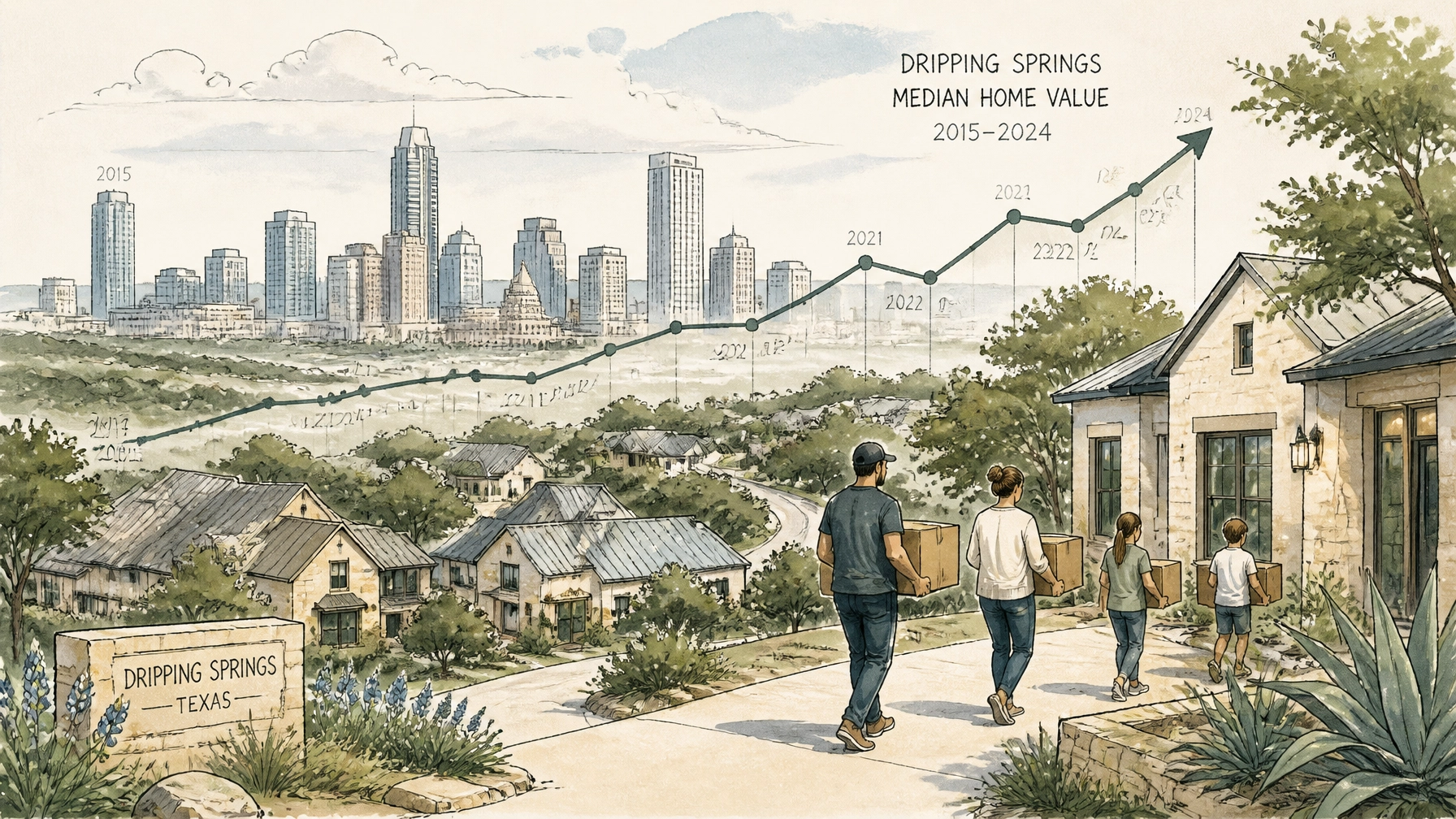
The headline is attention-grabbing, but the underlying trend is more nuanced than “millions of wealthy households” moving to Austin.
The Austin–Round Rock–Georgetown metropolitan area reached an estimated 2.62 million residents in 2025, up from approximately 2.35 million in 2020, according to U.S. Census Bureau population estimates. That represents growth of roughly 268,500 people in five years.
Not all of those newcomers are affluent, and not all are purchasing luxury homes. But the region is attracting a meaningful share of executives, business owners, technology professionals, and high-net-worth families. Their preferences are helping reshape demand across Austin’s western and southwestern edges: including Dripping Springs and the broader Hays County lifestyle market.
For retirees considering a move, the key takeaway is simple: Dripping Springs is not moving in lockstep with every other Austin-area neighborhood. Location, acreage, home quality, and price tier matter more than the metro-wide headline.
Austin’s Growth Is Being Fueled by Migration
Austin’s population growth has been driven primarily by migration rather than births alone.
From 2020 through 2024, the metro added approximately:
- 132,500 residents through domestic migration
- 71,200 residents through international migration
- More than 63,000 residents through natural increase
Together, domestic and international migration accounted for roughly three-quarters of the metro’s population growth during that period.
The Austin region population data summarized by Opportunity Austin reflects the broader appeal of Central Texas: employment opportunities, business expansion, outdoor amenities, and a lifestyle that combines urban access with more space.
For affluent households, the appeal can be especially strong. Austin offers established cultural and business amenities, while communities such as Westlake, Bee Cave, Driftwood, Wimberley, and Dripping Springs provide larger homes, more privacy, and a distinctly Hill Country setting.
That combination is important. Wealthy buyers are often not choosing between “Austin” and “Texas.” They are choosing between different versions of the Austin lifestyle.

Hays County Is Feeling the Ripple Effect
Hays County has become one of the most visible beneficiaries of Central Texas population growth.
County estimates show Hays County reaching approximately 292,000 residents in 2024, an increase of more than 10,000 people from the prior year. The Texas Demographic Center provides additional population estimates and long-range projections for the county.
Recent regional analysis attributed approximately:
- 72% of Hays County’s annual growth to domestic migration
- 13% to international migration
- 15% to natural increase
That pattern matters for real estate because people moving into the county are not all seeking the same thing. Some want a conventional suburban home. Others are looking for acreage, a custom build, a gated community, a winery-centered lifestyle, or a property that feels removed from the city without being isolated from it.
Dripping Springs sits directly within that conversation. Its proximity to Austin, reputation for wineries and events, rolling terrain, and growing collection of luxury homes make it a natural choice for buyers who want space without giving up access to the metro.
Still, it is important not to overstate the data. Hays County growth does not guarantee that every Dripping Springs home will rise in value. It does, however, create a larger and more diverse pool of potential buyers.
Luxury Real Estate Is Becoming a Two-Speed Market
The Austin-area housing market has not been moving uniformly.
A 2026 ZIP-code analysis of the Austin metro found that 48 of 75 ZIP codes experienced year-over-year median price declines, while the ultra-luxury tier: defined in that analysis as homes above $1.5 million: was the only price category with positive average gains. The full ZIP-level analysis also found that luxury homes priced between $1 million and $1.5 million were weaker than the very top tier.
Several high-end communities performed strongly:
- Westlake and West Lake Hills: Median sale prices rose to more than $2.3 million in ZIP code 78746.
- Bee Cave and the western Lake Austin corridor: ZIP code 78733 posted a significant increase in median sale price.
- Wimberley: ZIP code 78676 recorded one of the largest gains in the region, rising from approximately $673,000 in 2025 to more than $828,000 year to date in 2026.
Wimberley is not Dripping Springs, and its performance should not be treated as a direct forecast for ZIP code 78620. The communities have different housing inventories, buyer profiles, and development patterns.
But Wimberley does provide a useful regional signal: buyers with discretionary capital continue to value distinctive Hill Country settings, especially when properties offer privacy, views, land, and a strong sense of place.
That is the portion of the market most relevant to luxury Dripping Springs real estate.

What Could Support Dripping Springs Home Values?
Several factors may help desirable Dripping Springs properties remain competitive as affluent migration continues.
1. Scarcity of quality land
There is a limited supply of large, well-located parcels near Austin. As development expands, properties with mature oak trees, long views, usable acreage, and privacy may become more difficult to replicate.
2. Lifestyle-driven demand
Luxury buyers are not simply purchasing square footage. They may be buying proximity to wineries, restaurants, trails, golf, community events, and the slower rhythm of Hill Country living.
Dripping Springs’ growing cultural identity is part of the appeal. Retirees can explore the Dripping Springs art scene, attend local events, and enjoy outdoor spaces without living in a dense urban environment.
3. Custom-home appeal
Move-in-ready custom homes with thoughtful design, energy efficiency, outdoor living spaces, and age-friendly layouts may attract a narrower but more motivated buyer pool.
The strongest demand is not necessarily for the largest house. It may be for a home that combines privacy with manageable upkeep, single-level living, guest space, a covered patio, and an appealing view.
4. Continued access to Austin
Dripping Springs remains connected to Austin’s employment centers, healthcare resources, airport, restaurants, and cultural amenities. That access broadens its appeal beyond full-time retirees. Executives and business owners may see the area as a primary residence, while others may consider it for a future retirement move.
What This Means for Retirees Buying in Dripping Springs
For retirees and pre-retirees, a rising luxury segment can create both opportunity and caution.
A buyer may find more negotiating room in the broader market while facing stronger competition for an exceptional property. The best home for your lifestyle may not be the least expensive home available, but paying a premium should still reflect tangible benefits: location, construction quality, lot characteristics, privacy, and long-term usability.
Before purchasing, consider:
- How much of your net worth would be concentrated in the home
- Whether the property can be maintained comfortably later in retirement
- Ongoing costs for insurance, landscaping, utilities, repairs, and community fees
- Access to healthcare, shopping, airports, and family
- Whether the home’s design can support changing mobility needs
- How much liquid capital should remain available for retirement income
A primary residence can provide tremendous lifestyle value, but it is not as liquid as a portfolio of publicly traded stocks and traditional fixed-income investments. A retirement plan should account for both the emotional value of the home and the practical need for accessible resources.
What This Means for Retirees Selling
Sellers should avoid relying on a broad statement such as “Austin luxury is strong.” The more useful question is: How are comparable properties in this specific part of Dripping Springs performing?
A property with acreage, a well-maintained custom home, Hill Country views, and a practical floor plan may compete in a different market from a newer subdivision home or a property needing significant updates.
Sellers should pay attention to:
- Recent sales of genuinely comparable homes
- Price per square foot, without relying on it alone
- Days on market and price reductions
- Buyer expectations for updates and energy efficiency
- Outdoor living and land usability
- Whether the asking price reflects current conditions rather than a past peak
Affluent buyers may have more financial flexibility, but they are often highly selective. They can wait for the right home, negotiate when a property is overpriced, and compare Dripping Springs with other Hill Country communities.
The Bigger Picture
Austin’s growth is real. Hays County’s migration trends are meaningful. And luxury housing in select Hill Country locations is showing resilience that does not appear evenly across the metro.
But the future of Dripping Springs home values will not be determined by population growth alone. The market will continue to separate properties with enduring lifestyle appeal from those competing primarily on size or recent construction.
For retirees, that makes the decision personal as well as financial. Buying or selling in Dripping Springs should fit your desired pace of life, your housing needs, and your broader retirement income strategy: not simply a headline about wealthy newcomers.
Schedule a private meeting with a fiduciary financial advisor today by calling (512) 593-8380 or by visiting: https://calendly.com/portafoliocapital/15min
Portafolio Capital Management dba Mau Sanchez Capital is a Registered Investment Adviser. This content is for informational purposes only and does not constitute investment advice or a solicitation to buy or sell any security. Advisory services are provided only pursuant to a written advisory agreement.
To learn more about Portafolio Capital Management dba Mau Sanchez Capital, visit https://portafoliocapital.com/ or call (512) 593-8380.
This article may include stories, scenarios, and perspectives created or assisted by artificial intelligence. Although the individuals and circumstances described may be fictional, the topics are intended to reflect real financial, personal, and lifestyle issues that retirees and individuals commonly face.
The content is provided to encourage readers to consider different perspectives that may affect their retirement, regardless of whether they are currently planning, approaching retirement, or already retired. It is intended for general educational and informational purposes only and should not be interpreted as personalized investment, financial, tax, legal, medical, or retirement-planning advice.
Individual circumstances vary. Readers should independently verify any information presented and consult appropriately qualified professionals before making financial or personal decisions. No advisory, professional, or client relationship is created through the use of this website.
Leave a Reply