
For many retirees and pre-retirees, luxury Hill Country living means more than a beautiful home. It means less maintenance, greater comfort, thoughtful design, and a setting that supports a slower, more enjoyable pace of life.
That is why emerging housing concepts are attracting attention across Central Texas. From 3D-printed concrete homes to fractional ownership in private resort communities, new models are beginning to reshape how people think about second homes, retirement residences, and lock-and-leave living.
Some of these ideas are already real. Others remain more marketing vision than established housing solution.
For anyone considering a move to Dripping Springs, Wimberley, Spicewood, or the broader Austin Hill Country, it is worth understanding the difference.
3D-Printed Homes Have Moved Beyond the Demonstration Stage
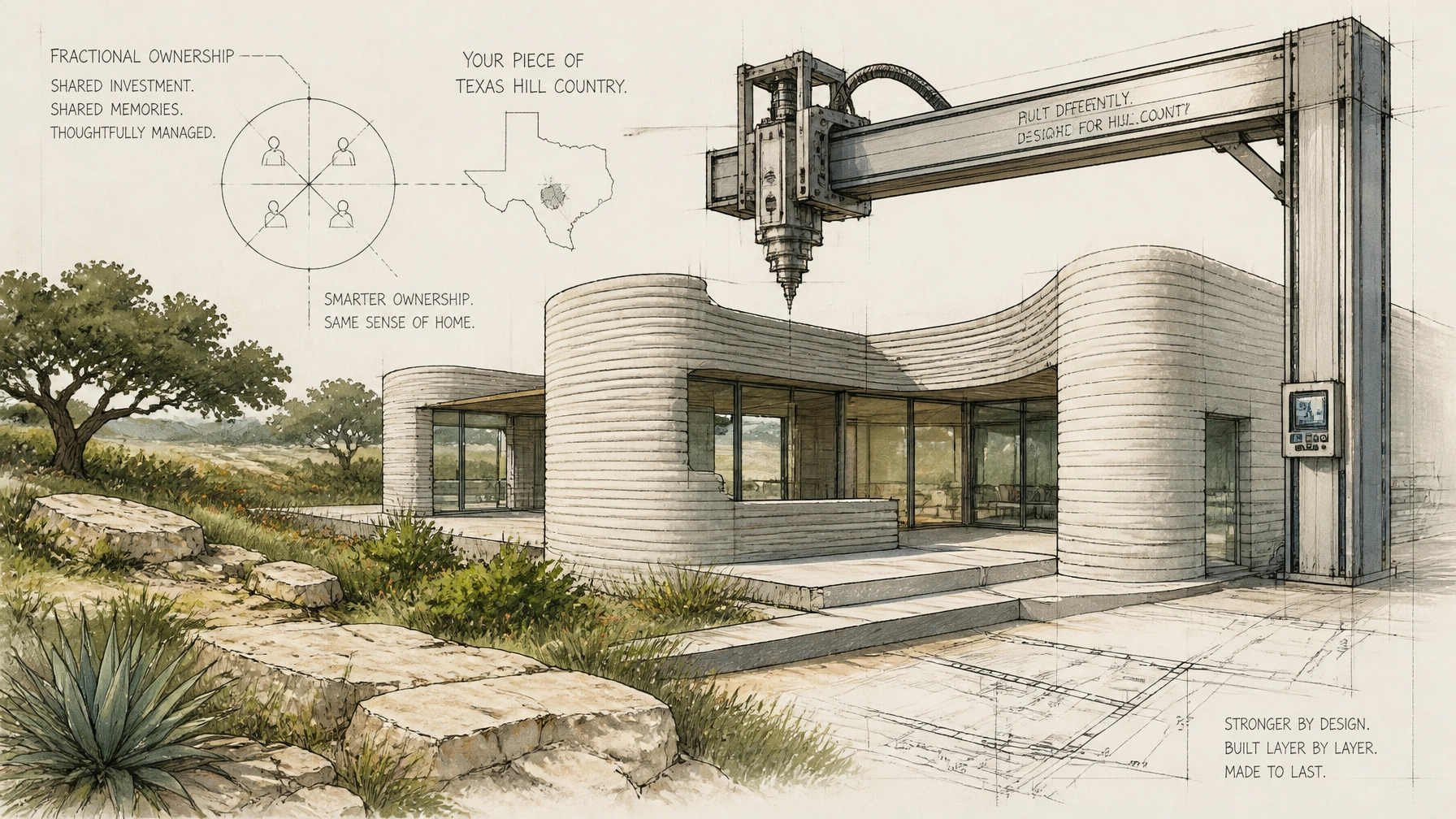
3D-printed housing is no longer limited to futuristic renderings or small experimental structures. In the Texas Hill Country, projects such as Wimberley Springs demonstrate how robotic concrete printing can be used in high-end residential construction.
According to ICON, Wimberley Springs includes five completed structures in Wimberley, Texas. The homes were designed by Bjarke Ingels Group and built using ICON’s Vulcan Block 3-4 printer. Floor plans include large, single-level designs with covered patios, attached garages, expansive windows, and strong connections to the surrounding landscape.
The design is particularly relevant to retirees because the homes are not simply technology showcases. They are intended to be comfortable, highly finished residences with open living areas and flexible private spaces.
The underlying construction process is different from traditional wood framing. A large printer deposits layers of a proprietary concrete-based material to form the walls. Roofs, windows, electrical systems, plumbing, interior finishes, and other components still involve conventional construction methods.
In other words, the home is not printed from foundation to furniture. The printed wall system is one part of a broader building process.

What Is Real: and What May Be Hype?
The potential benefits of 3D-printed construction are compelling:
- Distinctive architecture: Curved walls, built-in niches, and unusual forms can be easier to create.
- Reduced construction waste: Automated placement may use materials more precisely than some conventional methods.
- Thermal mass: Concrete walls can help moderate indoor temperature changes when combined with appropriate insulation and mechanical systems.
- Airtight construction: A well-designed wall envelope may reduce unwanted air infiltration.
- Durability potential: Concrete-based construction may offer meaningful resistance to pests, fire, and severe weather, depending on the complete building system.
- Faster wall construction: Printed wall sections may be completed more quickly than traditional framing in suitable conditions.
However, buyers should be cautious about treating every promised benefit as guaranteed. Actual project costs, construction timelines, energy savings, and long-term maintenance results depend on the site, design, contractors, building systems, and local conditions.
The Texas Real Estate Research Center at Texas A&M University has noted that questions remain about how consistently projected cost savings will appear in real-world projects. A faster wall-printing process does not eliminate site preparation, permitting, utility work, engineering, inspections, interior construction, or the need for experienced trades.
The technology is real. The assumption that it automatically produces a cheaper or simpler luxury home is less certain.
A Design Language That May Suit Aging in Place
One of the most interesting aspects of printed-home construction is its compatibility with flexible, long-term design.
House Zero, a demonstration home created through collaboration between Lake Flato and ICON, was designed as a permanent residence and field trial for ICON’s concrete wall printing system. The project description emphasizes flexibility for changing patterns of living and aging in place.
Lake Flato describes the home as:
“Built for permanence and resilience” and designed to support “the flexibility of ever-evolving patterns of living and aging-in-place.”
That philosophy can translate well to retirement planning. A thoughtfully designed Hill Country home might include:
- A primary suite on the main level
- Zero-step entries
- Wide doorways and clear circulation
- A flexible room for guests, hobbies, or future caregiving
- Covered outdoor space for enjoying the landscape without navigating difficult terrain
- Strong natural lighting and views
- Low-maintenance landscaping
- Storage and mechanical systems designed for practical access
These features are not exclusive to 3D-printed homes. A conventional custom builder can incorporate them as well. The technology matters less than the design objective: creating a home that remains useful as life changes.
Fractional Ownership: Luxury Access Without Full-Time Ownership
The second major trend is fractional ownership.
Instead of purchasing an entire second home, several buyers share ownership of one property. Each owner receives a defined usage schedule and typically shares expenses, maintenance responsibilities, and access to amenities.
The model is becoming visible in the Hill Country through The Canyon Club, a luxury residential resort community near Lake Travis in Spicewood. The development has announced five ICON 3D-printed homes, each approximately 3,400 square feet and designed with four bedrooms.
ICON’s announcement describes a model involving deeded fractional ownership, with one-eighth shares and six weeks of annual use. Some Canyon Club marketing materials have presented different share sizes and usage amounts, so prospective buyers should verify the current terms directly from the governing documents rather than relying solely on promotional material.
That distinction is important.
Fractional ownership is not the same as simply renting a vacation property. Depending on the structure, the buyer may own an interest in the real estate directly or own an interest in an entity that holds title. Those arrangements can have very different rights, obligations, and resale procedures.

Why Fractional Living May Appeal to Retirees
For some households, fractional ownership offers a practical middle ground.
It may be attractive to a retiree who:
- Wants regular access to the Hill Country without maintaining a full-time residence
- Splits time between Texas and another state
- Prefers professionally managed landscaping, cleaning, and repairs
- Enjoys resort amenities and social opportunities
- Does not expect to use a second home throughout the year
- Wants to test the region before making a permanent relocation
The lifestyle can be appealing: a well-appointed home, a predictable number of annual stays, and less responsibility for year-round upkeep.
But the arrangement requires a realistic understanding of ownership. You may have access to only a limited number of weeks while remaining responsible for your share of property taxes, insurance, maintenance, management expenses, reserves, and possible special assessments.
The effective cost per night may be higher than expected if you use the home less than planned.
The Due-Diligence Questions That Matter Most
Before considering a fractional home: or any nontraditional ownership structure: ask for the complete legal and financial documents.
1. What exactly do you own?
Determine whether you are purchasing:
- A direct deeded interest in the property
- Membership interests in an LLC that owns the property
- A contractual right to use the property
- Another form of ownership or participation
Do not assume that the word “deeded” answers every question. Review the title structure, liens, easements, covenants, and ownership documents with an independent real-estate attorney.
2. How does scheduling work?
Clarify how weeks are assigned and whether the system uses fixed dates, rotating priority, or a booking calendar.
Ask specifically about:
- Holidays and peak seasons
- Guest limits
- Pet policies
- Minimum stay requirements
- Exchanging or renting unused weeks
- What happens if another owner does not follow the rules
3. Who pays for major repairs?
A roof, HVAC system, exterior finish, driveway, or shared amenity can create a large expense.
Review the reserve policy and understand whether the community has funds set aside for future capital repairs. Also ask how special assessments are approved and divided among owners.
4. How easy is it to exit?
A fractional share is generally less liquid than a conventional home or a publicly traded investment. Ask whether there is an established resale marketplace, whether other owners have a right of first refusal, what transfer fees apply, and how long prior shares have taken to sell.
A sponsor’s statement that an interest “can be sold” is not the same as a guaranteed buyer or a predictable resale price.
5. How will lenders, insurers, and appraisers view it?
3D-printed homes and fractional interests are still unfamiliar to some lenders, insurers, and appraisers. Before committing, obtain written information about:
- Insurance classification and exclusions
- Financing availability
- Warranty coverage
- Appraisal methodology
- Local permitting and inspection approvals
- Restrictions on remodeling or resale
For a conventional full-ownership residence, these questions still matter. For a fractional home built with an emerging construction system, they deserve even more attention.

How to Think About the Financial Side
A luxury home can be central to a retirement lifestyle, but it is also a significant use of capital. The goal is not simply to buy the most innovative property available. It is to make sure the housing decision fits comfortably alongside ongoing income needs, healthcare costs, travel, family priorities, and a properly diversified portfolio.
For retirees considering a new build or fractional purchase, a sound planning conversation may include:
- Keeping sufficient liquid reserves for the purchase and ongoing costs
- Avoiding an excessive concentration of net worth in one property or region
- Maintaining an appropriate mix of publicly traded stocks and traditional fixed income
- Understanding recurring fees before comparing purchase prices
- Stress-testing the plan for lower-than-expected use, higher expenses, or a delayed resale
- Evaluating whether the home supports the desired lifestyle: not merely the novelty of the technology
As discussed in our article on choosing custom homes over resale in Dripping Springs, design choices can have lasting lifestyle implications. Emerging construction methods add another layer of opportunity, but also another layer of due diligence.
The New Frontier Is Worth Exploring Carefully
3D-printed homes and fractional ownership are not replacements for every conventional retirement housing choice. They are emerging tools that may suit a particular kind of buyer: someone who values distinctive design, Hill Country access, professional management, and a forward-looking approach to homeownership.
The most promising developments combine technology with timeless priorities: comfort, resilience, natural beauty, privacy, and ease of living.
The hype centers on novelty.
The real opportunity lies in asking whether the ownership structure, construction method, and total cost genuinely support the life you want to build in the Texas Hill Country.
Schedule a private meeting with a fiduciary financial advisor today by calling (512) 593-8380 or by visiting: https://calendly.com/portafoliocapital/15min
Portafolio Capital Management dba Mau Sanchez Capital is a Registered Investment Adviser. This content is for informational purposes only and does not constitute investment advice or a solicitation to buy or sell any security. Advisory services are provided only pursuant to a written advisory agreement.
To learn more about Portafolio Capital Management dba Mau Sanchez Capital, visit https://portafoliocapital.com/ or call (512) 593-8380.
This article may include stories, scenarios, and perspectives created or assisted by artificial intelligence. Although the individuals and circumstances described may be fictional, the topics are intended to reflect real financial, personal, and lifestyle issues that retirees and individuals commonly face.
The content is provided to encourage readers to consider different perspectives that may affect their retirement, regardless of whether they are currently planning, approaching retirement, or already retired. It is intended for general educational and informational purposes only and should not be interpreted as personalized investment, financial, tax, legal, medical, or retirement-planning advice.
Individual circumstances vary. Readers should independently verify any information presented and consult appropriately qualified professionals before making financial or personal decisions. No advisory, professional, or client relationship is created through the use of this website.
Leave a Reply