
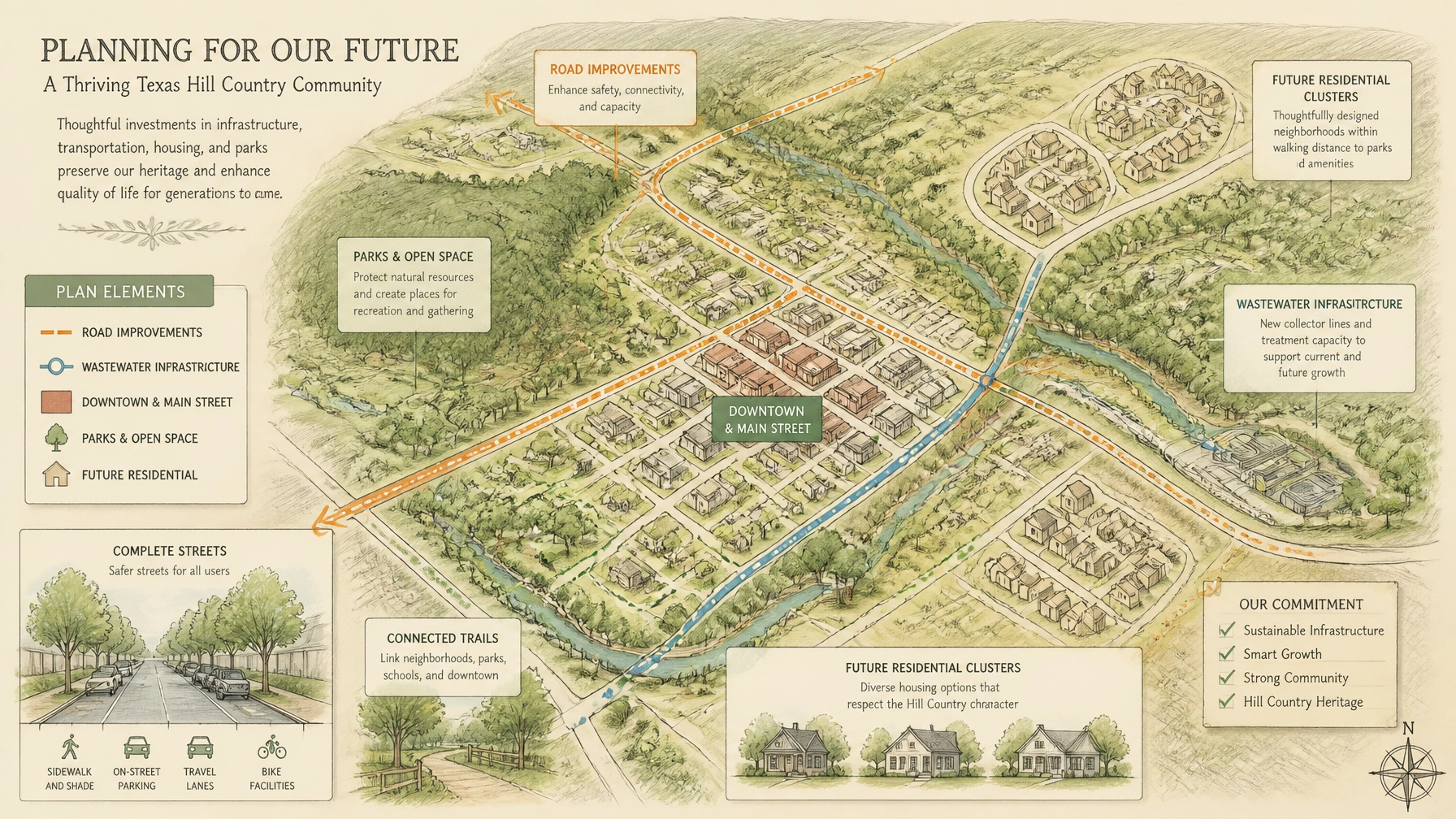
Dripping Springs has long attracted people looking for open skies, rolling limestone hills, local wineries, and a slower pace near Austin. But the community is no longer a quiet outpost on the edge of the metro area. Roads, utilities, neighborhoods, parks, and downtown spaces are all evolving.
For retirees and pre-retirees considering the area, that growth deserves a closer look. The most important question is not simply, “Is Dripping Springs growing?” It is:
What kind of place will Dripping Springs become as it grows: and will that future match the retirement lifestyle you want?
The city’s 2040 Comprehensive Plan describes itself as a long-term roadmap for managing development while protecting Hill Country character. Some of the items below are specific projects. Others are connected groups of studies, plans, and improvements that will unfold over many years. Timelines and designs may change, but together they offer a useful picture of Dripping Springs’ next decade.
1. South Regional Wastewater expansion

Wastewater infrastructure is not the most glamorous part of a retirement destination. It may, however, be one of the most important.
The City of Dripping Springs’ South Regional Wastewater Reclamation Facility is planned for a significant expansion. City materials describe a permitted future capacity of approximately 822,500 gallons per day, compared with the facility’s current capacity of roughly 162,500 gallons per day.
That additional capacity is designed to support future homes, businesses, and public facilities. It also matters environmentally. The city has discussed using treated effluent for irrigation at parks and open spaces, reducing the need to use drinking water for landscaping.
For someone planning a move, this project may shape several practical parts of daily life:
- Housing availability: Additional utility capacity can make more residential development possible.
- Community services: New neighborhoods often bring demand for medical offices, retail, restaurants, and other conveniences.
- Water and wastewater costs: Large infrastructure projects can affect utility rates and household budgets.
- Hill Country preservation: Reuse strategies may help balance growth with water conservation.
Reports indicate that design and construction timing has shifted over time, with completion estimates generally falling in the late-2027 to 2028 range. Prospective residents should review current updates rather than relying on an older projection.
The broader lesson is that utilities quietly determine where growth can occur. In Dripping Springs, wastewater expansion could be the foundation beneath nearly every other project on this list.
2. Road and corridor improvements along US 290 and RM 12

The Hill Country lifestyle is appealing partly because it feels removed from the city. That same distance can become frustrating when traffic, school trips, appointments, and daily errands all depend on a few major roads.
Transportation planning will be one of the defining issues for Dripping Springs over the next decade. TxDOT’s US 290 West projects and studies include long-range examinations of US 290 and RM 12, including safety, mobility, corridor design, and future traffic demand.
The work near Dripping Springs includes several different layers:
- The Oak Hill Parkway project east of Dripping Springs is intended to improve movement between US 290 and SH 71.
- TxDOT has studied the US 290 segment from RM 1826 toward Rob Shelton Boulevard.
- Additional feasibility work has examined US 290 from US 281 to RM 12.
- RM 12 is also the subject of safety and mobility planning.
- Local improvements near the US 290 and RM 12 intersection are being led by the city and other local entities.
For retirees, better connectivity could make the region easier to enjoy. A well-planned road network may improve access to Austin medical appointments, cultural events, airports, restaurants, and family visits. Sidewalks, trails, and safer crossings could also make short local trips more comfortable for people who prefer not to drive everywhere.
Still, road expansion can bring tradeoffs. Construction may create temporary disruption. Wider corridors can change the visual character of a community. More convenient regional access can also encourage additional development.
That is why it is useful to distinguish between mobility improvements and simply adding lanes. The long-term question is whether transportation planning helps Dripping Springs remain connected without losing its small-town feel.
3. Downtown reinvestment and TIRZ improvements

A strong downtown can make a growing community feel like a community rather than a collection of subdivisions.
Dripping Springs’ downtown area, including the Mercer Street corridor, is positioned for continued reinvestment. The city maintains information about TIRZ No. 1 and No. 2, which are tools used to help fund redevelopment and public improvements in designated areas.
Possible improvements associated with downtown reinvestment can include:
- More inviting sidewalks and pedestrian connections
- Streetscape and landscaping upgrades
- Utility improvements
- Better parking and circulation
- Public gathering spaces
- Support for local shops, restaurants, galleries, and small businesses
The goal is not to turn downtown into another high-rise urban district. The more relevant opportunity is to make the existing town center easier to visit, more attractive to residents, and better able to host community life.
That matters in retirement. A walkable downtown can provide places to meet friends, enjoy coffee, attend events, browse local art, or have dinner without making every outing a major excursion. It can also help new residents build connections, something many retirees value as much as square footage or views.
The city’s comprehensive planning materials emphasize preserving “the Hill Country character and the community’s sense of place.” Whether that goal succeeds will depend on the details: building scale, landscaping, traffic design, historic elements, and the relationship between new construction and existing businesses.
For homebuyers, downtown projects may also influence which parts of the area feel most convenient and connected in the future.
4. New master-planned and luxury Hill Country communities

Residential development will likely be the most visible sign of Dripping Springs’ growth.
Several large communities and subdivisions are planned or under construction in the region. Local development reporting has identified projects such as Double L, Wild Range, Cannon Ranch, the Ranch at Caliterra, Village Grove, and Ariza Springs, among others. The scale and status of these projects can change, so buyers should verify current information with the city, county, and individual developers.
The market is also seeing lower-density luxury communities with larger homesites, architectural guidelines, and a stronger connection to the surrounding landscape. These properties may appeal to retirees who want:
- A custom or semi-custom home
- More privacy and space
- Outdoor entertaining areas
- Access to trails or shared amenities
- A ranch-inspired architectural style
- Room for visiting children and grandchildren
At the same time, master-planned communities can offer advantages that acreage properties may not. Neighborhood amenities, organized maintenance, nearby retail, sidewalks, and social programming can make daily life more convenient.
The right choice depends on the lifestyle you imagine. Someone who wants a private garden, workshop, or expansive view may prefer a larger homesite. Someone who wants neighbors, amenities, and less exterior maintenance may find a planned community more appealing.
Our previous guide on custom homes versus resale homes in Dripping Springs explores some of these decisions in greater detail.
5. Parks, trails, and open-space improvements
Growth is easier to embrace when residents can still access nature.
Dripping Springs’ 2026 Parks, Recreation & Open Space Master Plan provides a framework for park development, recreation programming, and open-space preservation. The city is also pursuing improvements at Dripping Springs Ranch Park, including trail restoration and facility upgrades.
Over the next decade, the community’s park system may become increasingly important for:
- Walking and low-impact exercise
- Outdoor gatherings and festivals
- Equestrian activities
- Family visits
- Community events
- Access to green space as neighborhoods become denser
Parks are more than recreational amenities. They contribute to the daily rhythm of retirement. A nearby trail can make it easier to establish a walking habit. A shaded gathering area can become a natural meeting place. A community park can help residents feel connected to the town around them.
The challenge will be preserving quality and access as the population grows. New developments may add private amenities, but public parks and open spaces remain important because they are shared community assets.
What this growth could mean for your retirement
These five growth areas are closely connected. Wastewater capacity enables new homes. New homes increase pressure on roads and services. Downtown improvements can provide a civic center for a larger population. Parks and open spaces help preserve the lifestyle that attracted people in the first place.
For retirees considering Dripping Springs, the best approach is to look beyond a property’s current appearance. Consider:
- How close is the home to future road and construction activity?
- Will daily errands require driving on the busiest corridors?
- What public parks, trails, and gathering places are nearby?
- Are utility costs and neighborhood assessments consistent with your budget?
- Does the community’s future direction match your preferred pace of life?
- Will your retirement income support both housing costs and the lifestyle you want?
Dripping Springs will not look exactly the same in 2036 as it does today. The opportunity is to understand that change clearly and decide whether the evolving community still offers the peaceful, nature-focused, and welcoming retirement you envision.
Schedule a private meeting with a fiduciary financial advisor today by calling (512) 593-8380 or by visiting: https://calendly.com/portafoliocapital/15min
Portafolio Capital Management dba Mau Sanchez Capital is a Registered Investment Adviser. This content is for informational purposes only and does not constitute investment advice or a solicitation to buy or sell any security. Advisory services are provided only pursuant to a written advisory agreement.
To learn more about Portafolio Capital Management dba Mau Sanchez Capital, visit https://portafoliocapital.com/ or call (512) 593-8380.
This article may include stories, scenarios, and perspectives created or assisted by artificial intelligence. Although the individuals and circumstances described may be fictional, the topics are intended to reflect real financial, personal, and lifestyle issues that retirees and individuals commonly face.
The content is provided to encourage readers to consider different perspectives that may affect their retirement, regardless of whether they are currently planning, approaching retirement, or already retired. It is intended for general educational and informational purposes only and should not be interpreted as personalized investment, financial, tax, legal, medical, or retirement-planning advice.
Individual circumstances vary. Readers should independently verify any information presented and consult appropriately qualified professionals before making financial or personal decisions. No advisory, professional, or client relationship is created through the use of this website.
Leave a Reply