
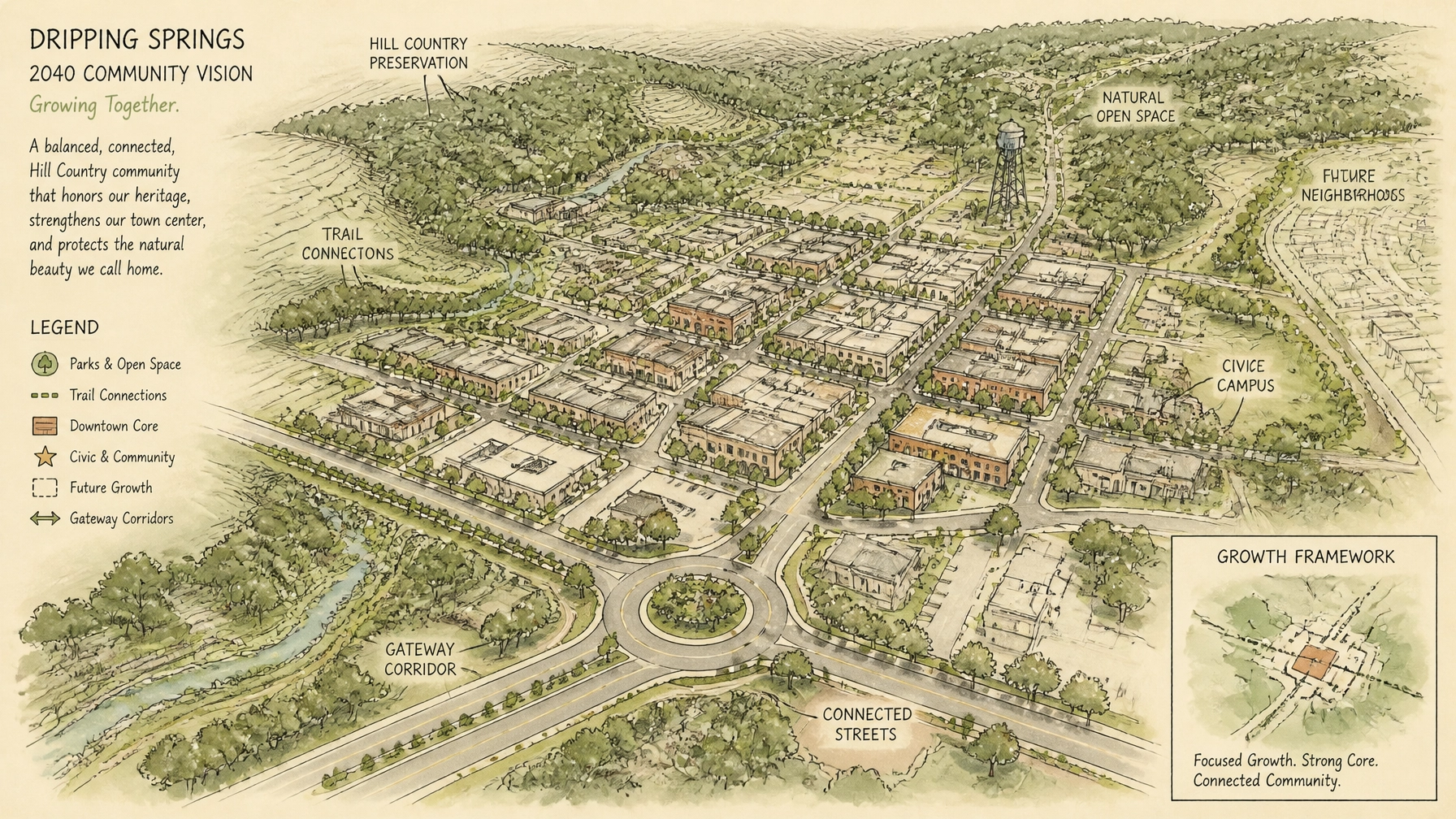
Dripping Springs is changing quickly. New neighborhoods, restaurants, wineries, businesses, and road projects are reshaping the community while the Texas Hill Country remains central to its appeal.
That creates an important question for homeowners and people considering retirement in the area: How can Dripping Springs grow without losing the small-town character, open spaces, and relaxed lifestyle that attracted people in the first place?
The City of Dripping Springs is addressing that question through “Reimagine Dripping Springs,” the draft 2040 Comprehensive Plan. The plan is intended to serve as a long-range policy guide for growth, housing, transportation, infrastructure, economic development, and community character.
It is not a zoning ordinance, a development approval, or a guarantee that a particular project will be built. Instead, it establishes a framework for future decisions. The City’s Planning & Development Department and the city’s official comprehensive plan information provide the latest materials and updates.
What Is “Reimagine Dripping Springs”?
The city began updating its previous comprehensive plan, adopted in 2015, after a process that included public meetings, stakeholder discussions, and workshops beginning in 2022. The new plan looks ahead toward 2040 and considers how the community can accommodate growth while preserving its identity.
The draft describes itself as a long-term roadmap for:
- Future land use and development
- Housing and neighborhood quality
- Roads and regional connectivity
- Parks, trails, and public facilities
- Water, wastewater, and other utilities
- Downtown and community character
- Economic development and funding
A key point is that the plan remains subject to public review, revisions, and formal action. The April 2026 city staff report explains that the draft was being advanced for additional public engagement and feedback.
For residents, that means this is more than a finished document to read once. It is an opportunity to understand the direction being considered: and to participate before the plan is finalized.
1. Growth: Making Room Without Losing the Hill Country
Growth is the central issue behind the 2040 plan. Dripping Springs is no longer a quiet outpost known only to longtime residents. It has become a desirable destination for families, business owners, executives, and retirees seeking land, scenery, and proximity to Austin.
The challenge is balancing two priorities:
- Providing room for new residents and businesses
- Protecting the natural landscape and small-town atmosphere
The plan’s community character goal is to:
“Manage growth and development, while prioritizing the preservation of the Hill Country character and the community’s sense of place.”
That language matters for current homeowners. Future land-use maps and development policies can influence where different types of growth may be encouraged, how new neighborhoods relate to existing areas, and how major projects are evaluated.
For retirees considering a move, the plan offers a useful reminder: Dripping Springs in 2040 will not look exactly like Dripping Springs today. The lifestyle may remain recognizable, but traffic patterns, commercial areas, housing choices, and public amenities are likely to evolve.
The most important question is not whether growth will happen. It is whether growth is coordinated with the infrastructure and community features residents value.

2. Housing: More Choices for Different Stages of Life
Housing is one of the plan’s dedicated goal areas. The draft calls for maintaining strong neighborhoods while providing housing options that meet the needs of current and future residents.
That broad goal could matter to retirees in several ways.
Some people moving to the Hill Country want a large custom home with views, guest space, and room for entertaining. Others prefer a smaller, lower-maintenance home close to restaurants, trails, medical services, and community activities. Pre-retirees may want a property that can serve them for decades rather than requiring another move later.
A wider range of housing choices can support those different preferences. It may also help adult children, caregivers, local workers, and aging residents remain connected to the community.
However, the comprehensive plan does not mean that every type of housing will appear in every neighborhood. Specific outcomes will depend on zoning, land-use decisions, development proposals, infrastructure capacity, and future city action.
For a closer look at one housing trend, see our article on why more retirees are choosing custom homes over resale properties in Dripping Springs.
3. Roads and Connectivity: The Daily-Living Question
Transportation is often discussed in terms of traffic counts and roadway capacity. For retirees, it is also a quality-of-life issue.
A road network affects how easily residents can:
- Reach medical appointments
- Visit downtown businesses and restaurants
- Access parks and trails
- Meet friends and attend community events
- Travel to Austin or nearby towns
- Host visiting family members
The plan’s connectivity goal is to:
“Provide an efficient and safe regional network of streets and highways.”
That language emphasizes both mobility and safety. The plan is intended to help guide decisions about future land use and major development corridors so that new growth is not considered separately from transportation needs.
For someone evaluating a future home, this suggests looking beyond the property itself. A beautiful Hill Country home may be appealing, but its location relative to major roads, shopping, healthcare, parks, and downtown will influence everyday convenience.
It is also worth remembering that a comprehensive plan is not the same as a construction schedule. It can identify priorities and preferred patterns, but individual roadway projects usually require separate design, funding, approvals, and implementation.
4. Parks, Trails, and Outdoor Life
Outdoor living is one of Dripping Springs’ strongest lifestyle attractions. Hiking, walking, cycling, golf, gardening, and time spent under the live oaks are important parts of the area’s appeal.
The comprehensive planning process has included the City’s Parks and Recreation Commission, and the plan addresses public facilities and infrastructure as part of its long-term vision. That creates an opportunity to think about parks not merely as isolated destinations, but as part of a connected community.
For retirees, quality parks can support more than recreation. Walking paths, shaded gathering areas, nature spaces, and accessible public facilities can encourage movement, social connection, and a slower daily rhythm.
A park within a short drive may be useful. A trail, green space, or neighborhood gathering area within easy reach can become part of a resident’s regular routine.

5. Downtown: Preserving the Sense of Place
Downtown and historic areas carry much of Dripping Springs’ identity. They provide the small-town experiences that are difficult to recreate in a large master-planned development: local shops, familiar faces, community events, restaurants, and places to gather.
The draft’s focus on community character and preservation suggests that downtown will remain an important part of the city’s long-term conversation. The plan also involved the Historic Preservation Commission in its review process.
That does not mean downtown will remain frozen in time. A healthy downtown may need updated sidewalks, safer crossings, improved public spaces, better access, and carefully considered redevelopment. The challenge is making improvements while retaining the scale, history, and visual qualities that make the area distinctive.
For retirees, downtown can be especially valuable as a social and cultural anchor. It offers opportunities to leave the car at home occasionally, enjoy a meal, attend an event, or maintain a sense of connection close to home.
Our newcomer’s guide to making friends and building community in Dripping Springs explores some of the lifestyle factors that make those connections possible.
6. Water and Utilities: The Foundation Beneath Growth
Water, wastewater, drainage, and other utilities may not be as visible as a new restaurant or neighborhood entrance, but they are essential to the region’s future.
The plan’s infrastructure goal is to:
“Ensure utilities, infrastructure and facilities are properly maintained and upgraded to serve community needs.”
That means future growth should be considered alongside the systems needed to support it. Water availability and wastewater capacity can influence where development occurs, how quickly areas can grow, and what upgrades may be necessary.
For current homeowners, infrastructure planning can affect reliability, future construction activity, and the broader cost of maintaining community systems. For retirees, it is a reminder to investigate utility arrangements carefully when comparing properties. City-served homes, homes in developments with shared systems, and rural properties can have very different maintenance responsibilities and long-term considerations.
The comprehensive plan provides policy direction. It does not replace detailed utility studies, engineering plans, rate decisions, or capital improvement programs. Those separate processes will continue to matter.
What the Plan Means for Current Homeowners
Current homeowners may want to watch the plan for four reasons:
- Future land use: Proposed land-use designations can provide insight into how nearby areas may evolve.
- Infrastructure priorities: Roads, utilities, and public facilities may influence convenience and future construction activity.
- Neighborhood character: Development standards and community-design goals can affect the relationship between established and new areas.
- Property decisions: Anyone considering remodeling, selling, building, or purchasing nearby land may benefit from understanding the city’s direction.
The plan does not automatically change a property’s zoning or determine its value. Real estate outcomes depend on many factors, including location, market conditions, taxes, insurance, water access, construction quality, and buyer demand.
Still, long-range planning can provide helpful context when making a major housing decision.
What It Means for Retirees Considering Dripping Springs
For retirees and pre-retirees, “Reimagine Dripping Springs” is best viewed as a guide to the community’s next chapter: not a promise that every proposed idea will happen exactly as described.
Before choosing a home, consider:
- How close you want to be to downtown, parks, and daily services
- Whether you prefer acreage, a neighborhood, or a lower-maintenance property
- How road access may affect your routine
- The property’s water and wastewater arrangement
- Future development patterns in surrounding areas
- Whether your housing choice can support changing needs over time
- How the purchase fits within your broader retirement income plan
A move to the Hill Country is both a lifestyle decision and a financial decision. Keeping sufficient liquidity for healthcare, home maintenance, travel, and unexpected costs can be just as important as selecting the right view or floor plan.
The Bottom Line
Dripping Springs is planning for a future in which growth, preservation, mobility, housing, parks, downtown vitality, and infrastructure must work together.
The 2040 plan will not answer every question, and it is still subject to public input and formal approval. But it offers current homeowners and prospective residents a valuable opportunity: to look beyond today’s listings and consider how the community may function in the years ahead.
For the latest information, review the City of Dripping Springs Planning & Development Department resources and the draft comprehensive plan materials.
Schedule a private meeting with a fiduciary financial advisor today by calling (512) 593-8380 or by visiting: https://calendly.com/portafoliocapital/15min
Portafolio Capital Management dba Mau Sanchez Capital is a Registered Investment Adviser. This content is for informational purposes only and does not constitute investment advice or a solicitation to buy or sell any security. Advisory services are provided only pursuant to a written advisory agreement.
To learn more about Portafolio Capital Management dba Mau Sanchez Capital, visit https://portafoliocapital.com/ or call (512) 593-8380.
This article may include stories, scenarios, and perspectives created or assisted by artificial intelligence. Although the individuals and circumstances described may be fictional, the topics are intended to reflect real financial, personal, and lifestyle issues that retirees and individuals commonly face.
The content is provided to encourage readers to consider different perspectives that may affect their retirement, regardless of whether they are currently planning, approaching retirement, or already retired. It is intended for general educational and informational purposes only and should not be interpreted as personalized investment, financial, tax, legal, medical, or retirement-planning advice.
Individual circumstances vary. Readers should independently verify any information presented and consult appropriately qualified professionals before making financial or personal decisions. No advisory, professional, or client relationship is created through the use of this website.
Leave a Reply