
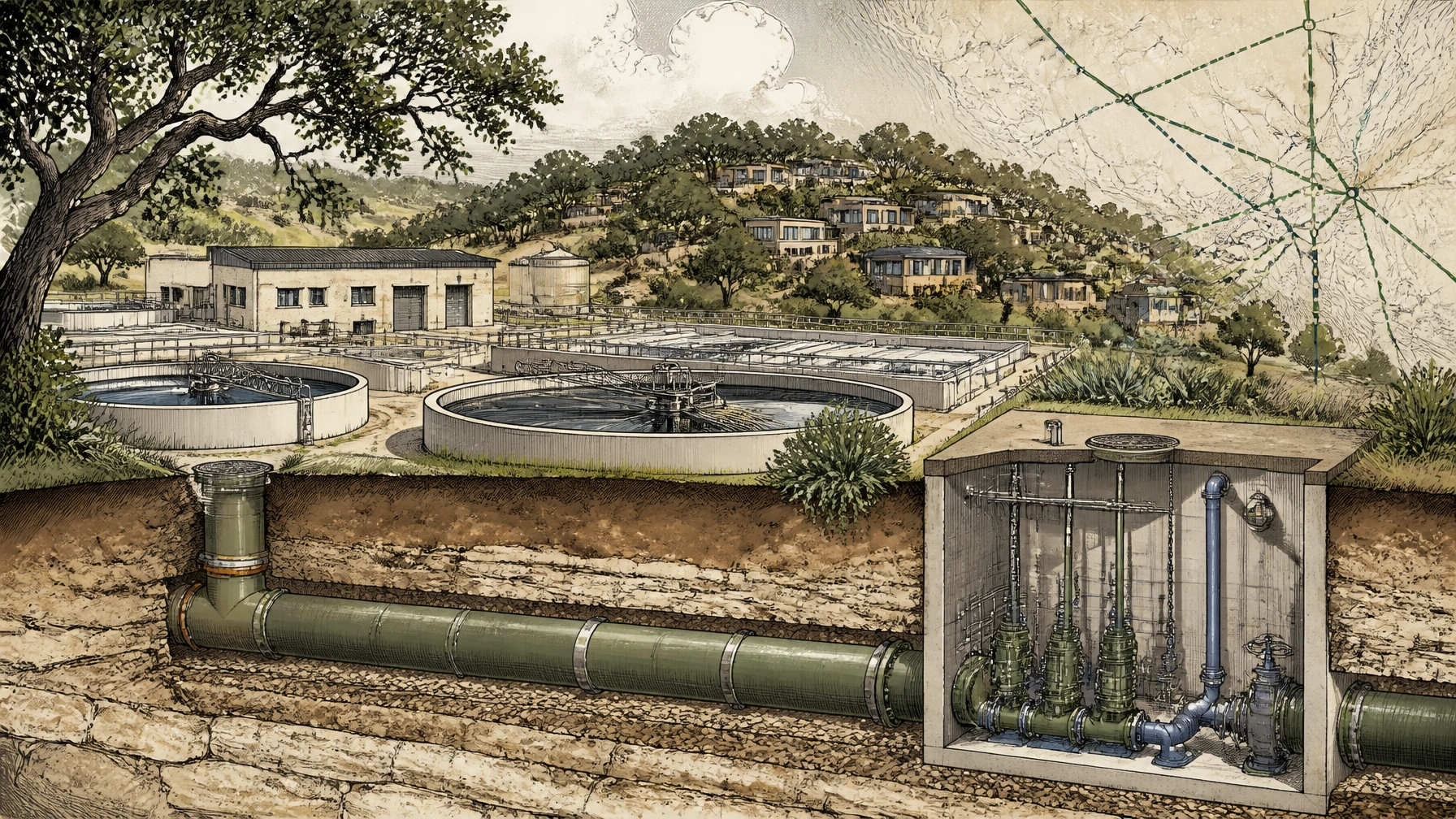
For many homeowners, wastewater infrastructure is easy to ignore: until the monthly utility bill changes.
In Dripping Springs, a major wastewater expansion is moving into a new phase. On July 23, 2026, the Texas Water Development Board approved $51,496,303 in financial assistance for wastewater system improvements in the city.
The project is designed to support continued growth, replace temporary treatment capacity, and create a more reliable long-term system. It is also contributing to higher wastewater rates for customers.
For retirees, pre-retirees, and anyone considering a move to the Hill Country, the story is about more than construction. It is about understanding how community growth can affect the cost of owning and maintaining a home.
First, a clarification about the “406%” figure
The title of this article reflects a figure that has circulated in connection with the Dripping Springs wastewater discussion. However, current official and local reporting does not show a 406% increase in the facility’s physical treatment capacity.
According to the Texas Water Development Board, the water reclamation facility is being expanded from 0.31 million gallons per day to 0.82 million gallons per day.
That represents an increase of approximately 165%, or a facility that will process roughly 2.6 times its previous daily capacity.
The “406%” number may reflect a comparison involving a particular customer charge or rate category. A large percentage increase can result when an older fee starts from a very low base. For example, a charge rising from $5 to $25 is a 400% increase, even though the dollar difference is $20.
The distinction matters:
- Capacity figures describe how much wastewater the system can treat.
- Rate figures describe what customers pay for water and wastewater service.
- A very high percentage change in one rate category does not mean the city is adding 406% more treatment capacity.
What the $51.5 million project includes
The approved assistance is not simply for a new building. It supports a broader wastewater system improvement program involving planning, design, construction, and related infrastructure.
The funding package includes:
- $48,580,000 in financing
- $2,916,303 in principal forgiveness
- An estimated $10.3 million in savings over the life of the loan through the Clean Water State Revolving Fund
The physical improvements include a larger water reclamation facility, a new lift station, approximately 19,065 feet of force main, updated headworks, solids handling and dewatering systems, secondary treatment, chemical feed systems, electrical infrastructure, ultraviolet disinfection, an effluent holding pond, and approximately 4,900 feet of treated effluent lines.
The city also plans to decommission its temporary wastewater treatment plant and develop an asset management plan.
In practical terms, the goal is to replace a patchwork of temporary solutions with a more durable system capable of supporting a growing community.
“With the assistance approved today, the City will expand its water reclamation facility from 0.31 million gallons per day to 0.82 million gallons per day.” : Texas Water Development Board

Why Dripping Springs needs more capacity
Dripping Springs is no longer a quiet rural outpost on the edge of Austin. It has become one of the most sought-after areas for Hill Country living, attracting executives, business owners, families, and retirees who want more land, a slower pace, and access to Austin’s employment, medical, dining, and cultural amenities.
That growth brings benefits, including new restaurants, neighborhoods, services, and outdoor amenities. It also creates pressure on roads, utilities, water resources, and wastewater systems.
A 2026 State of the City report from Community Impact noted that multiple residential developments are underway or in planning around Dripping Springs. The same report explained that the city needed an additional $51.5 million because of cost increases over several years.
The project has also faced delays. According to KVUE’s reporting, litigation delays, rising operating expenses, construction inflation, and the cost of running temporary wastewater plants all contributed to the financial pressure.
This is one of the less visible realities of fast-growing communities: the lifestyle may remain peaceful, but the infrastructure supporting it must grow quickly behind the scenes.
How utility bills are expected to change
Dripping Springs approved a wastewater rate adjustment scheduled to appear with September 2026 billing.
Local reporting indicates that:
- Wastewater rates are increasing by nearly 40% overall.
- Many residential customers may see an increase of approximately $20 to $30 per month.
- The exact amount will depend on usage and the customer’s service classification.
- Water rates are also changing, although the city has described the water portion as a much smaller adjustment than the wastewater increase.
- Rates are expected to be evaluated annually, with additional increases anticipated through fiscal year 2032.
The city’s wastewater rate adjustment information should be the first stop for homeowners who want to review the current rate schedule and billing details.
“Many residential customers will see an increase of about $20 to $30 a month, depending on usage.” : KVUE
A $20-to-$30 monthly increase equals approximately $240 to $360 per year. That may be manageable for one household, but it becomes more important when combined with property insurance, maintenance, landscaping, healthcare, vehicle costs, and other recurring expenses.
For a retiree living primarily on portfolio withdrawals, Social Security, pension income, or a combination of sources, recurring increases deserve attention because they continue whether markets are strong or weak.
What retirees should factor into a Dripping Springs budget
1. Build a realistic recurring-cost estimate
When evaluating a potential home, it is common to focus on the purchase price, property taxes, and insurance. Utilities can receive less attention because they appear smaller in isolation.
A better approach is to estimate the complete monthly cost of ownership, including:
- Water and wastewater
- Electricity and natural gas
- Internet and communications
- Property insurance
- Landscaping and tree care
- Security and monitoring
- Routine maintenance
- Road, neighborhood, or community fees
A $25 monthly utility increase may not change a relocation decision by itself. But it should be included in the same household cash-flow model as every other recurring expense.
2. Ask which provider serves the property
Not every property in the broader Dripping Springs area is served by the same utility provider. The 2026 State of the City report identifies three providers serving the area:
- West Travis County Public Utility Agency
- Dripping Springs Water Supply Corporation
- City of Dripping Springs
Before purchasing a home, confirm the specific water and wastewater provider, rate schedule, connection fees, and any applicable usage tiers.
This is especially important when comparing a home inside the city limits with a property in the surrounding area or extraterritorial jurisdiction.
3. Consider the home’s size and lifestyle
A large luxury home with extensive landscaping, guest accommodations, outdoor kitchens, and frequent visitors may have a different utility profile than a smaller, low-maintenance residence.
Homebuyers should consider how their intended lifestyle affects monthly costs. A couple planning to travel for several months each year may use less water than a household hosting family regularly or maintaining large gardens and outdoor spaces.
Dripping Springs’ appeal often includes acreage and generous outdoor living. Those features are meaningful, but they may also require more maintenance and resource planning.
4. Keep liquidity available for the unexpected
A new utility charge is predictable. A failed pump, damaged tree, roof repair, or major HVAC replacement is not.
Retirement planning should leave room for both regular bills and irregular costs. For many households, that means maintaining an accessible reserve rather than committing every available dollar to a home purchase, renovation, or construction project.
This principle also matters for those building a custom home. As discussed in Why More Retirees Are Choosing Custom Homes Over Resale, a new home can offer modern efficiency and aging-friendly design, but the project still requires careful liquidity planning.

A healthier system can support long-term livability
Higher utility rates are never welcome, particularly for households already managing a carefully structured retirement budget. At the same time, reliable infrastructure is part of what makes a community livable over the long term.
For Dripping Springs, the wastewater expansion is intended to support growth while reducing reliance on temporary treatment facilities and improving the system’s ability to serve residents in the future.
That does not eliminate the need for homeowners to monitor costs. It simply places the increase in a broader context: the community is investing in the infrastructure required to support the Hill Country lifestyle that continues to attract new residents.
For anyone considering a move, the right question is not only, “What will my utility bill be this year?” It is also, “How will recurring costs fit into the way I want to live for the next 20 or 30 years?”
A thoughtful retirement income plan should account for inflation, changing housing expenses, healthcare needs, travel, family support, and the everyday costs of maintaining a home. Transparent, liquid investments and appropriate portfolio construction can help provide flexibility as those costs evolve.
Schedule a private meeting with a fiduciary financial advisor today by calling (512) 593-8380 or by visiting: https://calendly.com/portafoliocapital/15min
Portafolio Capital Management dba Mau Sanchez Capital is a Registered Investment Adviser. This content is for informational purposes only and does not constitute investment advice or a solicitation to buy or sell any security. Advisory services are provided only pursuant to a written advisory agreement.
To learn more about Portafolio Capital Management dba Mau Sanchez Capital, visit https://portafoliocapital.com/ or call (512) 593-8380.
This article may include stories, scenarios, and perspectives created or assisted by artificial intelligence. Although the individuals and circumstances described may be fictional, the topics are intended to reflect real financial, personal, and lifestyle issues that retirees and individuals commonly face.
The content is provided to encourage readers to consider different perspectives that may affect their retirement, regardless of whether they are currently planning, approaching retirement, or already retired. It is intended for general educational and informational purposes only and should not be interpreted as personalized investment, financial, tax, legal, medical, or retirement-planning advice.
Individual circumstances vary. Readers should independently verify any information presented and consult appropriately qualified professionals before making financial or personal decisions. No advisory, professional, or client relationship is created through the use of this website.
Leave a Reply